A Fierce Guardian of the Keris – 19th-Century Bali
Impossible de charger la disponibilité du service de retrait
Prix habituel
$461.00 USD
Prix habituel
Prix promotionnel
$461.00 USD
Dimensions: H 61.5 × W 18 cm
Weight: 1.2 kg
Origin: Bali, Indonesia
Period: 19th century
Material: Carved wood with polychrome and gilt decoration
A Balinese Polychrome and Gilt-Wood Keris Holder
Bali, Indonesia, 19th century
Carved in the round as a fierce standing guardian figure, the face with large protruding eyes, broad nose and open fanged mouth, wearing an elaborate headdress and richly ornamented costume, the surface decorated in black, red, green and yellow pigments with extensive remains of gilt decoration, the hands positioned to support the scabbard of a keris, the figure standing upon an integral base.
The pronounced facial expression and highly animated treatment of the body belong to the dramatic visual vocabulary of Balinese guardian and demonic figures. Such figures were particularly suited to the presentation of the keris, an object whose significance in Bali extended considerably beyond that of a weapon.
The Keris Holder in Balinese Culture
Known in Bali in various sculptural forms, wooden keris holders were made to support a keris vertically when it was not being worn. Examples were used in domestic and courtly settings, and holders in the form of powerful mythological or guardian figures were particularly appropriate for an object regarded as possessing status and spiritual significance.
Comparable historic examples are carved as figures associated with the Hindu epics and Balinese protective imagery, including Rawana, Hanuman and other guardian or demonic subjects. The precise identity of the present figure is left open in the absence of a defining attribute.
Carving and Surface Decoration
The sculptor has given particular attention to the head and costume. Deeply cut ornament surrounds the face and headdress, while the clothing is articulated through raised bands, scrolling elements and geometric details.
Much of the original decorative scheme remains visible. Areas of red, green, yellow and black polychromy are interspersed with extensive gold-coloured decoration, now worn irregularly across the raised surfaces.
Microscopic Examination
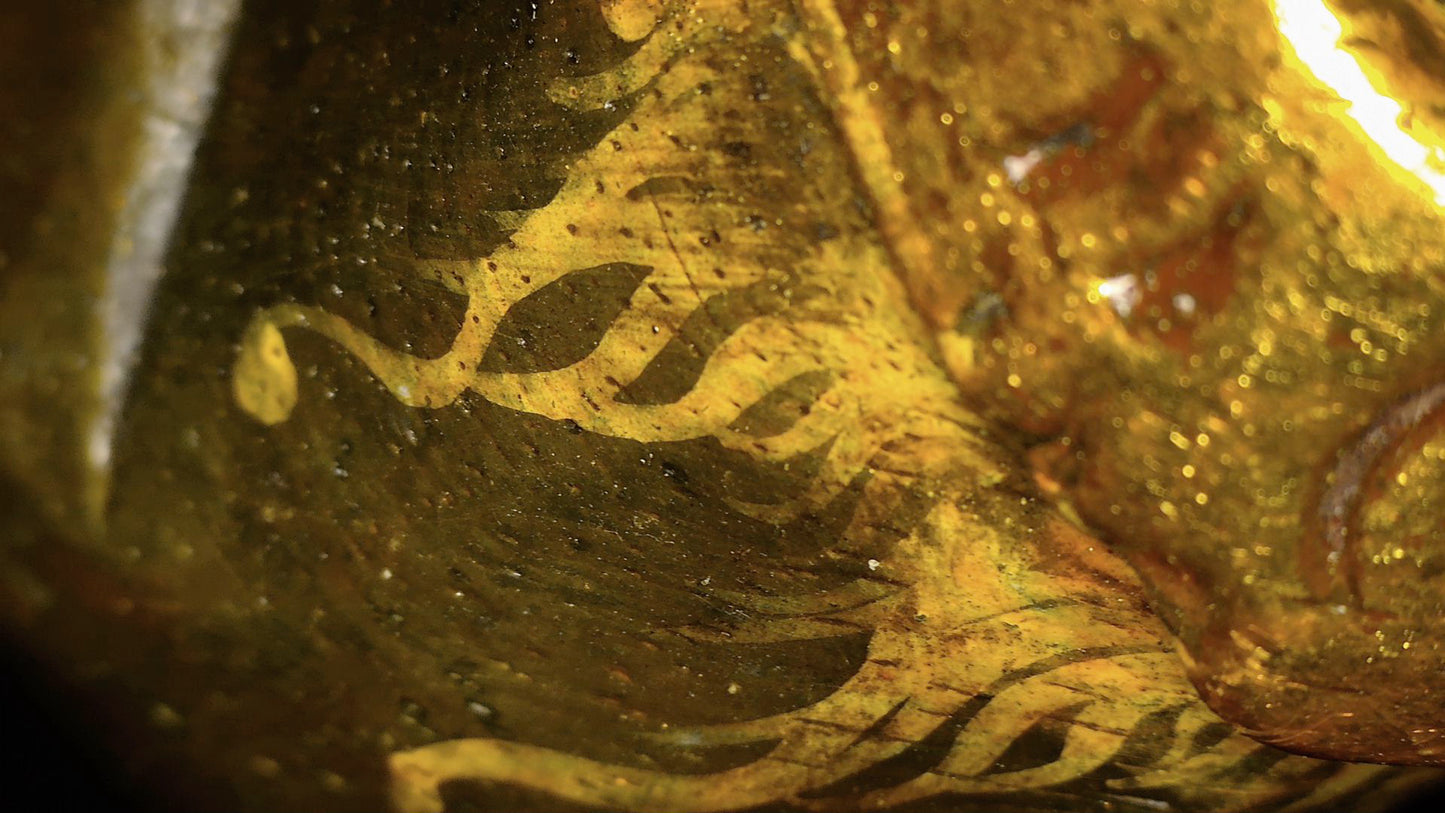
Examination under magnification reveals a complex stratigraphy to the surviving surface.
The gilt areas are not preserved as a uniform modern coating. The uppermost points display considerable abrasion, while gold remains more strongly preserved within recessed carving, incised lines and protected areas. Fine scratches cross the decorated surface at different depths, indicating successive periods of handling and wear.
In several areas, reddish and reddish-brown material is visible beneath and adjacent to the surviving gold. Elsewhere, losses reveal successive pigment and preparation layers before reaching the underlying timber.
The coloured surfaces show similarly varied patterns of deterioration. Green, yellow, red and black passages display differences in abrasion, cracking and exposure of underlying material, producing a layered surface consistent with repeated ageing and use.
The Underside
The underside remains largely untreated and provides an important view of the timber itself.
Deep radial shrinkage, longitudinal cracking and deterioration around the heartwood are clearly visible. The principal splits follow the natural grain rather than cutting mechanically across it, while the exposed surface retains irregular carving and tool marks.
The contrast between this heavily aged timber and the surviving decorated exterior is particularly noteworthy. The ageing is therefore not confined to the painted surface but extends into the structural wood of the sculpture.
Condition
With extensive wear consistent with age and use, including shrinkage cracks, losses and abrasion to the polychrome and gilt decoration, local deterioration of the timber, scratches and minor losses to carved details.
The surviving surface has deliberately not been extensively cleaned or refinished, preserving the relationship between the polychromy, gilt decoration and exposed wood.
Dating
The carving, construction, surviving polychromy and gilt decoration, together with the pronounced ageing visible in the exposed timber, support an attribution to 19th-century Bali.
At 61.5 cm in height, the present example is an imposing survival of the Balinese tradition of sculptural keris presentation, retaining an unusually expressive combination of carving, colour and historic surface.