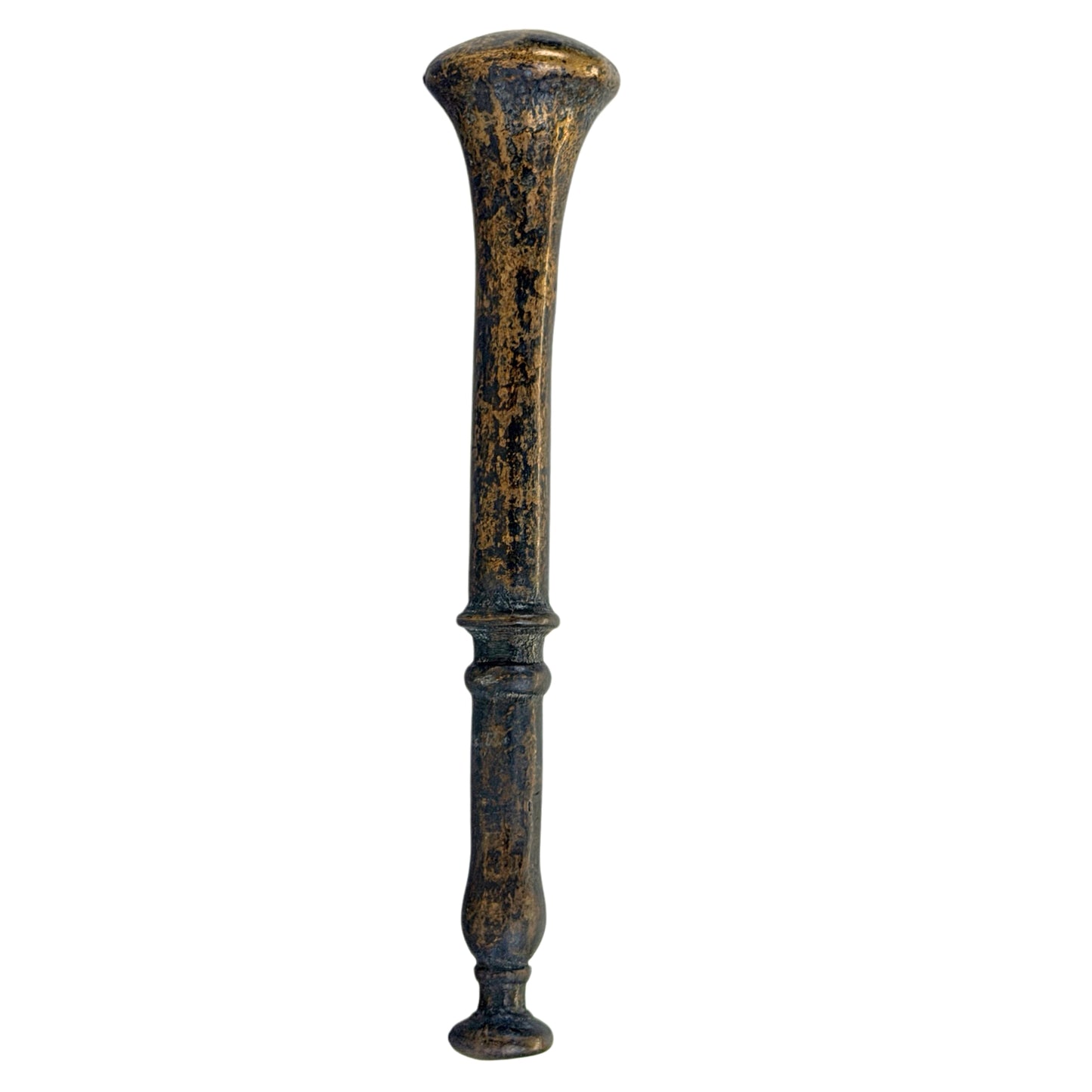
19th-Century Apothecary Mortar & Pestle with Crowned Lion Crest
Impossible de charger la disponibilité du service de retrait
Prix habituel
$224.00 USD
Prix habituel
Prix promotionnel
$224.00 USD
| Dimensions (Mortar): | H 12 × W 15 cm |
| Dimensions (Pestle): | H 18.5 × W 3.5 cm |
| Total Weight: | 1.8 kg |
| Material: | Cast Bronze |
| Origin: | Italy |
| Period: | Late 19th century, c. 1880–1900 |
A Late 19th-Century Italian Bronze Mortar and Pestle
Conceived for functional utility, this heavy antique bronze mortar and accompanying pestle were crafted in Italy toward the close of the nineteenth century. With a combined weight of 1.8 kg, the set exhibits the solid structural integrity typical of utilitarian apothecary vessels produced during this era.
The cylindrical bowl flares outward smoothly toward an expansive, gently everted rim flanked by robust, spherical side handles. Centuries of handling and environmental aging have endowed the bronze surface with a deep, dark brown patina, punctuated by lighter highlights across the most prominent high points.
Crowned Coat of Arms with Rampant Lion
A defining feature appears on opposing sides of the exterior wall, where a heraldic cartouche displays a rampant lion surrounded by decorative scrolling and surmounted by an open crown.
While reminiscent of Northern European heraldry, comparative examples of late-nineteenth-century Italian metalwork confirm this design as a classic decorative vocabulary rather than a reference to the Dutch national coat of arms.
Original Bronze Pestle
Retaining its original heavy bronze pestle measuring 18.5 cm in length, the set displays consistent signs of authentic historical wear, including a darkened, uneven patina and smoother, brighter metal along the primary contact zones.
The proportions of the pestle complement the mortar seamlessly, creating an attractive and unified complete set.
Construction, Patina, and Wear Patterns
The interior well features a rich accumulation of age-related patination alongside visible signs of usage, while the upper rim displays local wear where the underlying bronze has turned lighter and warmer in tone.
Additionally, the flat base bears numerous overlapping scuffs and friction marks from active functional employment. These physical traces, combined with the wear on the pestle, handles, and rim, confirm that the object served a practical purpose over an extended period rather than existing solely as a decorative piece.
Dating and Comparative Context
The form, dimensions, weight, spherical side handles, and specifically the crowned heraldic lion align closely with documented Italian bronze mortars from the second half of the nineteenth century, with comparable specimens generally attributed to the final quarter of the century.
Based on these typological parallels, this piece is conservatively dated around 1880–1900.
A Characterful Piece of European Utilitarian Ware
While many antique mortars feature relatively plain surfaces, the dual heraldic decoration gives this example a distinct character. The warm bronze tones, deep age patina, and preserved pestle make it equally appealing as an independent interior statement or a collector's piece.
A fine complete Italian bronze mortar from the late nineteenth century that brings together traditional craftsmanship, daily function, and European decorative history.