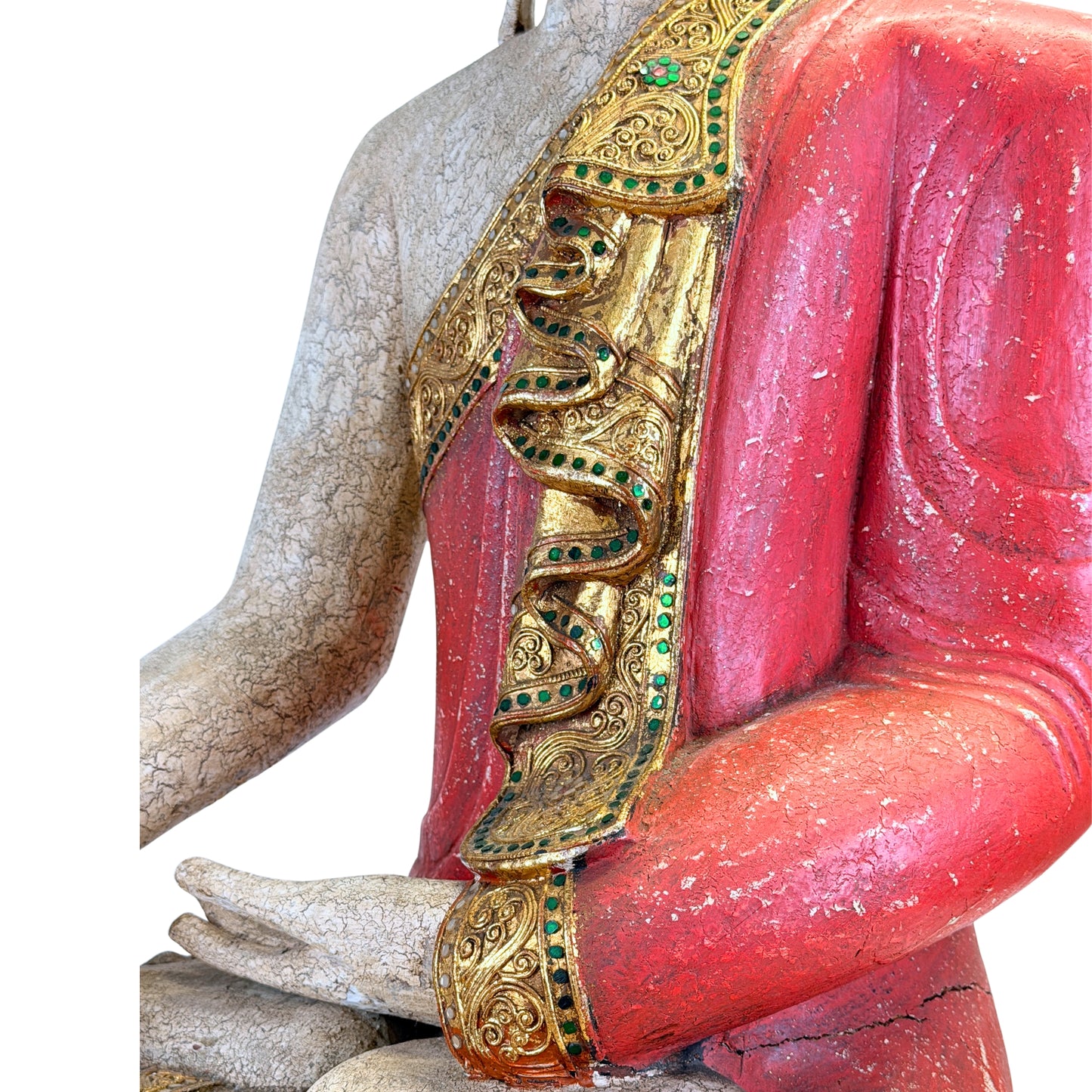
A Striking Burmese Buddha in Red and Gold – 1970s
Impossible de charger la disponibilité du service de retrait
Prix habituel
$1,152.00 USD
Prix habituel
Prix promotionnel
$1,152.00 USD
Dimensions: H 87 × W 79 cm
Weight: 28.4 kg
Material: Solid wood, polychrome decoration, gold-toned detailing and mirror inlay
Origin: Burma (Myanmar)
Period: 1970s
Gesture: Bhumisparsha Mudra
Made to command a room
This is not a small devotional figure. At 87 cm high, almost 80 cm wide and weighing 28.4 kg, the Buddha has the broad proportions and physical presence of a substantial Burmese wooden sculpture.
Its character comes immediately from the surface. Deep red robes surround a pale body, while gold-toned ornament and small pieces of reflective mirror create highlights across the garment and throne. From different angles, these elements catch the light and continually change the appearance of the sculpture.
We date the figure to the 1970s. Rather than presenting it as an earlier antique, we regard it as an expressive example of the continuation of traditional Burmese Buddhist craftsmanship during the second half of the 20th century.
A continuation of Burmese decorative tradition
Buddhist sculpture in Myanmar did not suddenly abandon established forms with the arrival of the modern period. Workshops continued to produce religious images using familiar postures, decorative vocabulary and regional techniques.
This Buddha belongs within that continuing tradition. Its broad seated posture and elaborate ornament retain associations with the artistic language of Mandalay, while the strong colour contrasts and extensive decorative treatment give it the more exuberant character associated with later Burmese work.
Mandalay influence rather than an early Mandalay date
The term Mandalay is useful here as a stylistic reference rather than as a claim that the sculpture was produced during the historic Mandalay period.
The figure demonstrates how this visual tradition continued to influence Burmese workshops well into the 20th century. This distinction is important when evaluating large wooden Buddhas whose traditional appearance can otherwise encourage unnecessarily early dating.
Built from substantial sections of solid wood
Turning the sculpture over reveals much about its construction. The Buddha is assembled from several substantial pieces of solid timber rather than being made as a lightweight decorative shell.
The underside remains largely exposed, allowing the grain, joins and working marks to be examined. This substantial construction accounts for the considerable weight of 28.4 kg.
Natural movement within the timber
A pronounced shrinkage crack extends through part of the seated structure. Such movement is characteristic of large sections of timber as they respond over decades to changes in humidity and temperature.
We regard this as part of the natural ageing of the sculpture rather than evidence for a substantially earlier date.
Mirror inlay, colour and gold decoration
The most elaborate workmanship is concentrated around the robe and lower part of the figure. Small reflective elements are incorporated among geometric and floral ornament, accompanied by areas of red and gold-toned decoration.
Some elements have been lost over time and others have become worn or subdued. The resulting surface is considerably softer and less uniform than it would have appeared when the Buddha was first completed.
This combination of painted wood, reflective inlay and gilded-looking decoration gives the sculpture a distinctly Burmese identity and makes it particularly effective when displayed in changing natural or interior light.
The cracked surface of the face and body
The pale areas covering the face, neck, arms and hands display a pronounced network of craquelure. Darker material visible within the cracks creates a strongly aged appearance.
We do not use this craquelure as evidence for a 19th-century date. Examination under magnification suggests that it should instead be understood as part of the decorative surface treatment and the subsequent ageing of that finish.
Ageing without overstating age
After approximately half a century, the sculpture has developed genuine wear of its own. Abrasion, cracking, small losses, discolouration and movement within the wood are now part of its history.
There is therefore no need to assign the Buddha an artificially early date in order to explain its present appearance.
Bhumisparsha – calling the earth to witness
The right hand reaches downward across the knee while the left rests open in the lap. This is the Bhumisparsha Mudra, commonly known as the earth-touching gesture.
It refers to the moment immediately before enlightenment when Siddhartha Gautama called upon the earth to bear witness to his spiritual achievement.
Within Buddhist iconography, the gesture has consequently become associated with resolve, stability and enlightenment.
More than fifty years of visible history
The sculpture has not been cosmetically restored to resemble a newly finished Buddha. Craquelure, losses to the painted and gold-toned decoration, missing or damaged mirror elements, surface wear, shrinkage cracks and local discolouration remain visible.
These characteristics should be considered part of the condition and visual identity of the piece.
Despite these signs of age, the overall composition remains remarkably powerful. The broad silhouette, contrasting colours and reflective decoration allow the Buddha to retain a strong presence even when viewed from across a large room.
A decorative Burmese Buddha with genuine character
The appeal of this sculpture lies less in extreme antiquity than in its combination of scale, craftsmanship and unmistakable Burmese visual language.
It works particularly well as a focal piece in a spacious interior, meditation room, entrance hall or other setting where its unusual width and rich surface can be appreciated from a distance.
A substantial Burmese Buddha from the 1970s, handmade in solid wood and distinguished by its bold red, gold and mirror-decorated surface.