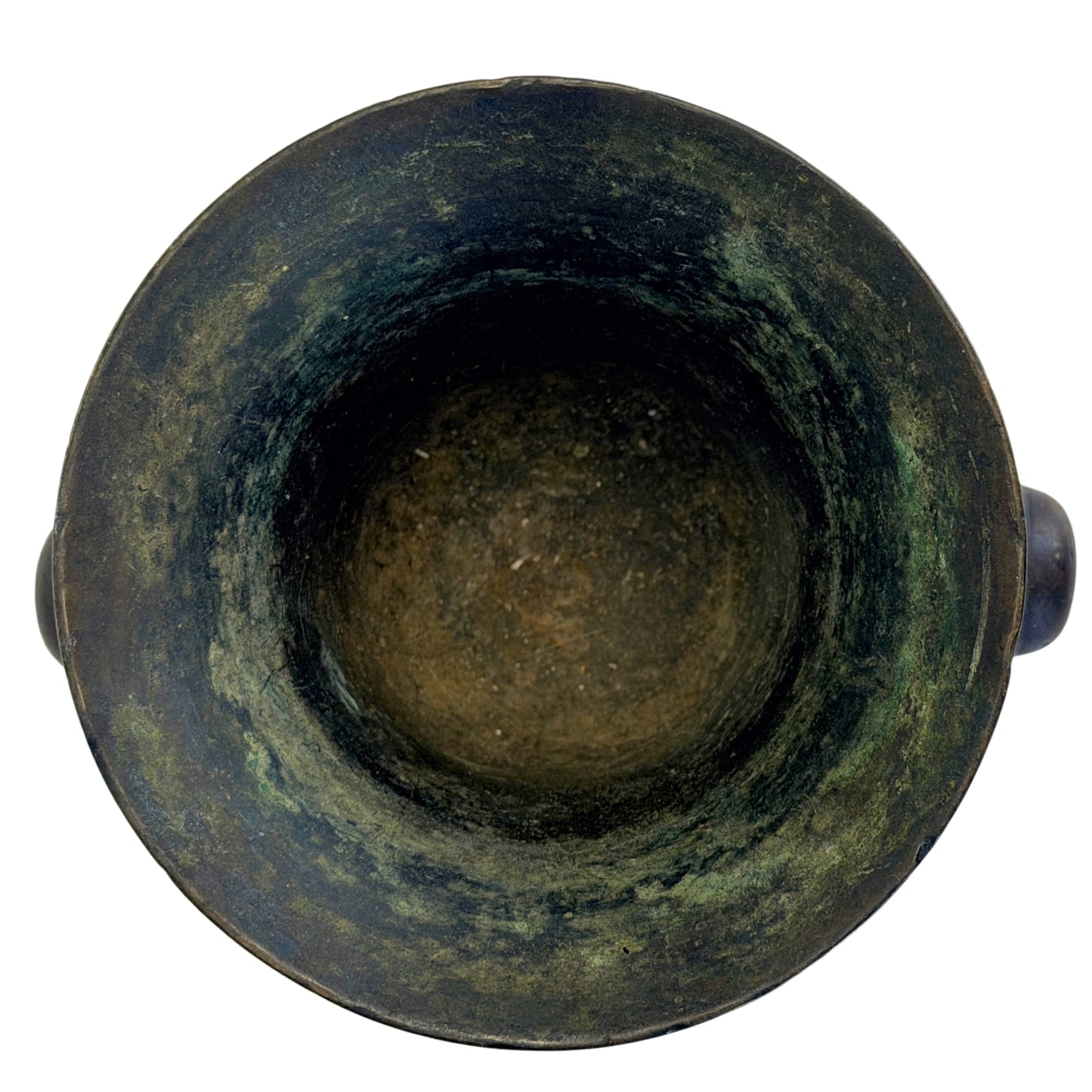
A Dutch Bronze Mortar and Pestle – 17th Century
Impossible de charger la disponibilité du service de retrait
Prix habituel
$467.00 USD
Prix habituel
Prix promotionnel
$467.00 USD
Dimensions:
Mortar: H 11.5 × W 15 cm
Pestle: H 20 × W 3.7 cm
Total weight: 3 kg
A substantial 17th-century Dutch bronze mortar with associated pestle, distinguished by its unusually solid proportions, warm surface and pronounced architectural profile.
The mortar is cast as a deep cylindrical vessel rising from a broad moulded foot. Its exterior is articulated by a succession of horizontal ribs and mouldings, culminating in a widely flared rim. Two opposing knob-shaped handles project from the central register, giving the otherwise functional vessel a particularly balanced and sculptural appearance.
A Working Object from the Early Modern Household
Mortars of this type were not conceived as decorative objects. They belonged to the practical equipment of pharmacies, apothecaries and prosperous households, where they were used for grinding herbs, spices and medicinal preparations.
The considerable weight of this example is characteristic of an object intended to remain stable during repeated use. At approximately 3 kilograms including the pestle, it has the physical presence expected from a heavily cast utilitarian bronze.
Surface and Evidence of Use
Much of the appeal lies in the surface. Centuries of handling have produced a complex brown and golden patina across the exterior, with darker deposits retained around the mouldings and handles.
The interior presents a markedly different character. Here, darker oxidation and areas of natural green verdigris have developed within the recesses, while the base shows extensive circular wear consistent with prolonged grinding and pounding.
These variations are important: rather than presenting a uniformly finished surface, the mortar shows different patterns of wear according to how each part of the object was handled and used.
The Pestle
The accompanying bronze pestle measures 20 cm in length and follows a restrained baluster form with expanded working ends. Its darkened surface and softened high points complement the mortar well and give the ensemble a convincing sense of long practical use.
A Strong Example of European Bronze Domestic Ware
Surviving bronze mortars occupy an interesting position between domestic history and European metalwork. Although made primarily as tools, their weight, symmetry and carefully moulded profiles often gave them a degree of craftsmanship far beyond their purely practical function.
This example retains precisely that character: compact, exceptionally heavy for its size and visually powerful, with the patina and wear remaining clearly visible rather than having been polished away.
Origin: The Netherlands / Low Countries
Period: 17th century
Material: Cast bronze
Condition: Age-related wear, oxidation, surface marks and natural patination consistent with prolonged historical use.