An Early Chinese Stone Guanyin Stele in Anjali Mudra – Possibly Northern Wei, 5th–6th Century – 45.6 cm
Impossible de charger la disponibilité du service de retrait
Prix habituel
$34,844.00 USD
Prix habituel
Prix promotionnel
$34,844.00 USD
Dimensions: H 45.6 × W 23 cm
Weight: 15.5 kg
Material: Dense grey-green stone, provisionally identified as argillite / argillaceous siltstone
Origin: China
Subject: Crowned Bodhisattva, probably Guanyin (Avalokiteshvara)
Attribution: Possibly Northern Wei / Northern Dynasties, 5th–6th century
A Monumental Presence on an Intimate Scale
Despite measuring only 45.6 cm in height, this remarkable Chinese Buddhist stele has the physical presence of a considerably larger sculpture. Carved from an exceptionally dense stone and weighing 15.5 kg, the figure rises almost architecturally from the original block.
The crowned Bodhisattva sits frontally with the hands joined before the chest in Anjali Mudra. The restrained expression, elongated eyes, formal symmetry and deeply organised drapery give the sculpture an unmistakably archaic character. The figure is most plausibly interpreted as Guanyin, the Chinese manifestation of Avalokiteshvara, although no surviving attribute permits an absolute identification.
Its unusual sculptural vocabulary has prompted extensive examination. Rather than relying upon a single stylistic feature, the attribution has been considered through the stone itself, carving technique, microscopic surface evidence, weathering, traces of former decoration and comparison with early Chinese Buddhist sculpture.
The Stone as Evidence
The extraordinary weight is the first indication of the nature of the material. The stele is carved from a compact grey-green stone with an extremely fine matrix. Its appearance and fracture behaviour are consistent with argillite or argillaceous siltstone, although a definitive geological identification would require laboratory analysis.
The rear presents an entirely different character from a prepared modern surface. It remains rugged and irregular, with natural undulations, laminar fractures and extensive weathering. Grey, green, brown and ochre areas occur throughout the surface, producing a complex mineral skin that has developed within and upon the stone.
Of particular interest is the contrast between the massive, dense body of the sculpture and its vulnerable outermost surface. Certain weathered areas have undergone pronounced de-cohesion and can release extremely thin, brittle flakes.
Examination of an Existing Fracture
A minute fragment from an already compromised area provided an opportunity to examine the internal character of the material. Rather than disintegrating into recognisable sand grains, the material separated as a thin, compact flake with a smooth and very fine structure.
The detached fragment was subjected to a simple vinegar test. No visible effervescence occurred. While this is not a substitute for petrographic analysis, the absence of an obvious carbonate reaction makes an ordinary calcite-rich limestone less convincing and supports the provisional identification of a silica-rich argillaceous stone.
The newly exposed fracture also provides a valuable contrast with the heavily altered exterior. This difference between the compact interior and weathered surface is an important part of understanding the condition of the sculpture.
Evidence Under Magnification
Microscopic examination reveals considerably more complexity than is apparent to the naked eye.
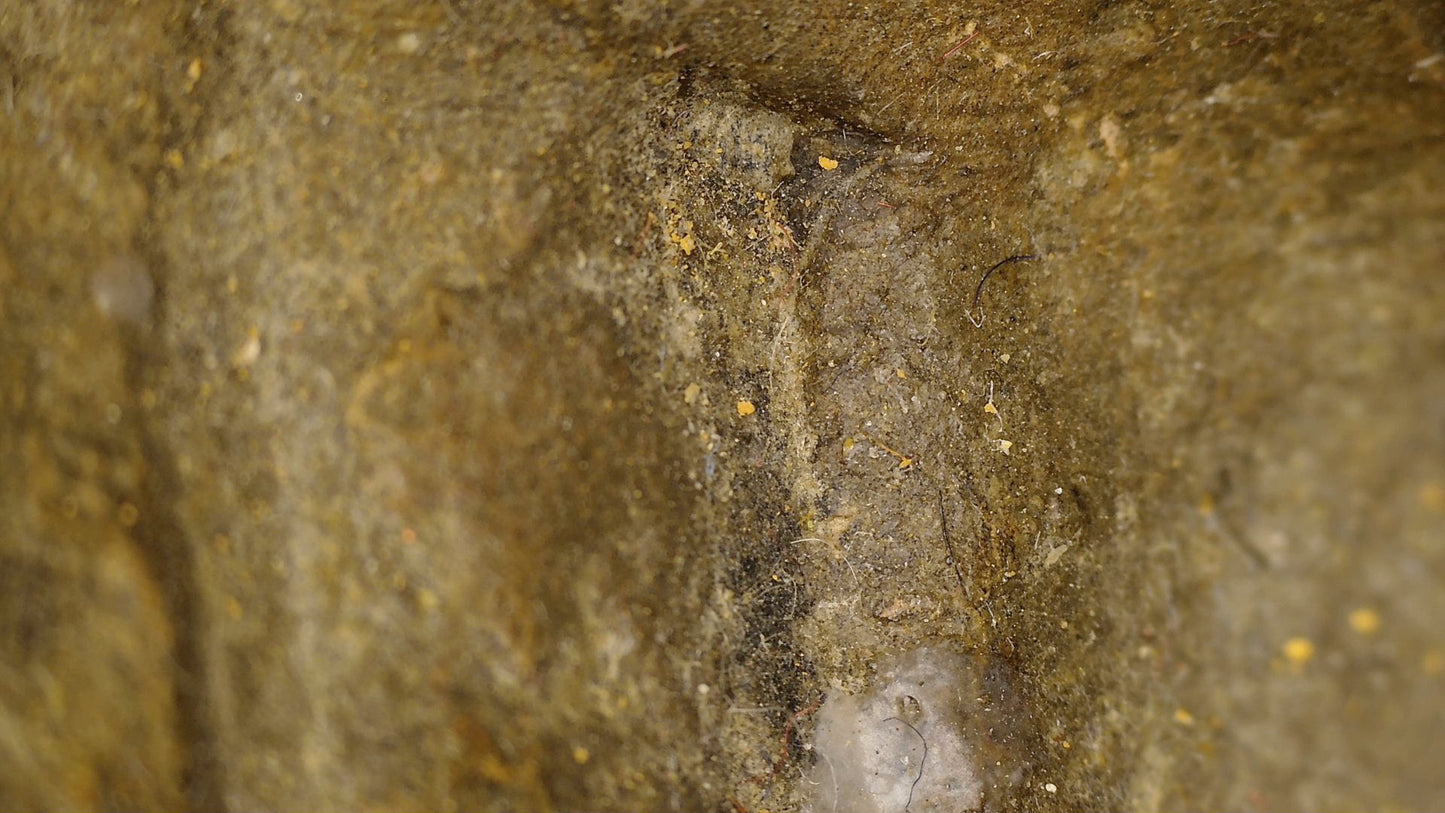
Recessed areas preserve irregular deposits of different colours and textures, while carved grooves display non-uniform tool marks rather than repetitive mechanical finishing. In several places, the ageing of the surface continues into the carved recesses themselves. Edges have softened, mineral material has accumulated within depressions and the original cutting has become integrated into the weathered surface.
These observations are consistent with traditional hand carving followed by substantial natural ageing. They cannot independently establish a 5th- or 6th-century date, but they form an important part of the cumulative evidence surrounding the object.
Surviving Gold-Coloured Traces
Magnification also revealed minute gold-coloured particles surviving within protected recesses.
They do not present themselves as a uniform recent coating. Instead, they occur as isolated remnants embedded among older surface deposits and sheltered areas of the carving.
This is particularly intriguing in the context of early Chinese Buddhist sculpture. Stone images were historically capable of being painted, prepared and embellished rather than necessarily being displayed as bare stone.
The particles have therefore been recorded as possible remnants of an earlier decorative or gilded surface. No claim is made that they are chemically confirmed gold, nor can their age be established without analytical testing.
The Crossed Feet and Two Lotus Supports
Perhaps the most distinctive feature of the composition occurs beneath the seated figure.
The legs terminate in crossed feet which are not simply placed upon a conventional continuous plinth. Instead, the feet are associated with two separately carved rounded supports. Although considerable erosion has simplified their original modelling, their symmetrical arrangement suggests individual lotus supports.
This initially unusual detail has important parallels within early Chinese Buddhist sculpture.
Published documentation of the Yungang cave temples records crowned Bodhisattvas seated upon stool-like structures in combination with lotus supports at the feet. Another documented figure in Cave VIII is specifically described with both feet resting upon a three-petalled lotus positioned in front of the seated figure.
The present sculpture is not identical to those monumental cave carvings. The significance of the comparison lies instead in the sculptural concept: a seated Bodhisattva, an elevated throne-like arrangement and deliberately articulated lotus elements associated with the feet all belong to the visual vocabulary found in early Northern Chinese Buddhist art.
An Archaic Sculptural Language
The face has been conceived with remarkable economy. Long eyes sit beneath strongly defined brows, the nose descends in a simple continuous form and the restrained mouth gives the figure an expression of inward concentration rather than later naturalistic softness.
The crown or elaborate coiffure is equally architectural. Individual masses rise prominently above the head rather than dissolving into fine ornamental detail.
Below, the robes are organised through deeply cut linear folds. The sculptor was concerned less with reproducing soft fabric than with creating rhythm across the stone. Parallel incisions and strongly separated planes establish the body through pattern and structure.
This combination of frontal authority, simplified anatomy and graphic drapery is one of the principal reasons why the sculpture warrants comparison with the Buddhist artistic traditions of China's Northern Dynasties.
Anjali Mudra
The Bodhisattva joins both hands vertically before the chest in Anjali Mudra, known in Chinese Buddhist terminology as hezhang (合掌).
The gesture expresses reverence, devotion and spiritual homage. Its prominent position at the centre of the composition reinforces the devotional rather than narrative character of the sculpture.
The crown and Bodhisattva appearance make an identification as Guanyin (Avalokiteshvara) plausible. Nevertheless, Anjali Mudra is not exclusive to Guanyin and no surviving identifying attribute makes the attribution certain.
Dating: Why the Northern Dynasties Are Being Considered
A Northern Wei or broader Northern Dynasties attribution is presently the most compelling working hypothesis, placing the possible creation of the sculpture within approximately the 5th–6th century.
That attribution is based upon a convergence of observations: the archaic facial construction, frontal presentation, Bodhisattva iconography, linear treatment of the robes, unusual arrangement of the feet and lotus supports, traditional carving, dense weathered stone and microscopic evidence preserved across the surface.
There is, however, no surviving dated inscription and no documented early provenance capable of independently fixing the sculpture to that period.
A later Chinese archaistic interpretation must therefore remain within the differential assessment. Chinese sculptors repeatedly revisited prestigious earlier Buddhist traditions, and considerable age alone does not prove Northern Wei manufacture.
For this reason the 5th–6th century is presented as an attribution rather than an absolute date.
Condition
The sculpture survives with extensive historic wear, erosion, losses, mineral deposits and surface alteration consistent with its considerable age.
Several areas of the outer weathering layer are fragile and exhibit active flaking or de-cohesion. The sculpture should consequently be handled carefully and should not be aggressively cleaned.
The irregular reverse, exposed fractures, worn carving and surviving deposits have deliberately been left visible. They constitute important physical evidence and form an integral part of the object's historical character.
A Sculpture That Rewards Close Examination
This is not an object whose importance rests on one inscription or a single diagnostic feature. Its fascination lies in the accumulation of evidence.
The extraordinary 15.5 kg weight, unusual grey-green stone, weathered fracture structure, hand-cut recesses, microscopic surface deposits, possible remnants of former gilding and the distinctive double lotus arrangement beneath the crossed feet together create an unusually compelling object for the study of early Chinese Buddhist sculpture.
Our present attribution places it within, or in close relationship to, the artistic tradition of the Northern Dynasties and possibly the Northern Wei period of the 5th–6th century.
A powerful and enigmatic Chinese Buddhist stone sculpture whose age, material history and surviving surface continue to reveal details far beyond those immediately visible to the naked eye.