Antique Balinese Wood Sculpture with Original Gilding – Indonesia c. 1900
Couldn't load pickup availability
Dimensions: H 67.8 × W 18.5 cm
Weight: 4 kg
Origin: Bali, Indonesia
Date: c. 1890–1930
Material: Hand-carved solid wood with polychrome decoration and surviving gold leaf
Antique Balinese Wood Sculpture with Original Gilding
A striking example of traditional Balinese wood carving, this tall ceremonial figure combines courtly elegance with the religious visual language for which Bali is renowned. The sculpture dates to around the turn of the 20th century and retains something increasingly difficult to find: an extensively aged surface in which the original craftsmanship, decoration and later history remain visible.
The male figure is represented frontally, his hands held together before his chest in the traditional sembah gesture. In Balinese culture this gesture expresses reverence and respect and is closely associated with ceremonial and devotional practice.
His elaborate crown, jewellery, elongated ornaments and richly decorated costume identify him as a figure of elevated status. He may represent a royal, heroic or divine personality from the Balinese Hindu tradition. Without an original temple context or documented provenance, however, we prefer not to assign the sculpture to a specific deity or character.
Surviving Gold Leaf Beneath a Century of Wear
One of the most interesting discoveries during our examination was the presence of genuine surviving gold leaf. Small areas of gold remain protected within recesses of the crown, costume and carved ornamentation, while exposed surfaces have lost considerably more of their original finish.
This differential wear is particularly revealing. Raised areas such as the face, hands, feet and projecting decoration have been repeatedly worn, while pigment and gilding survive more strongly inside protected details.
Close examination also reveals a complex decorative structure beneath the visible surface. Red layers and pale preparation layers can be seen where the upper decoration has been lost. Rather than presenting a uniform modern finish, the sculpture preserves a fragmented sequence of earlier surface treatments.
What the Underside Reveals
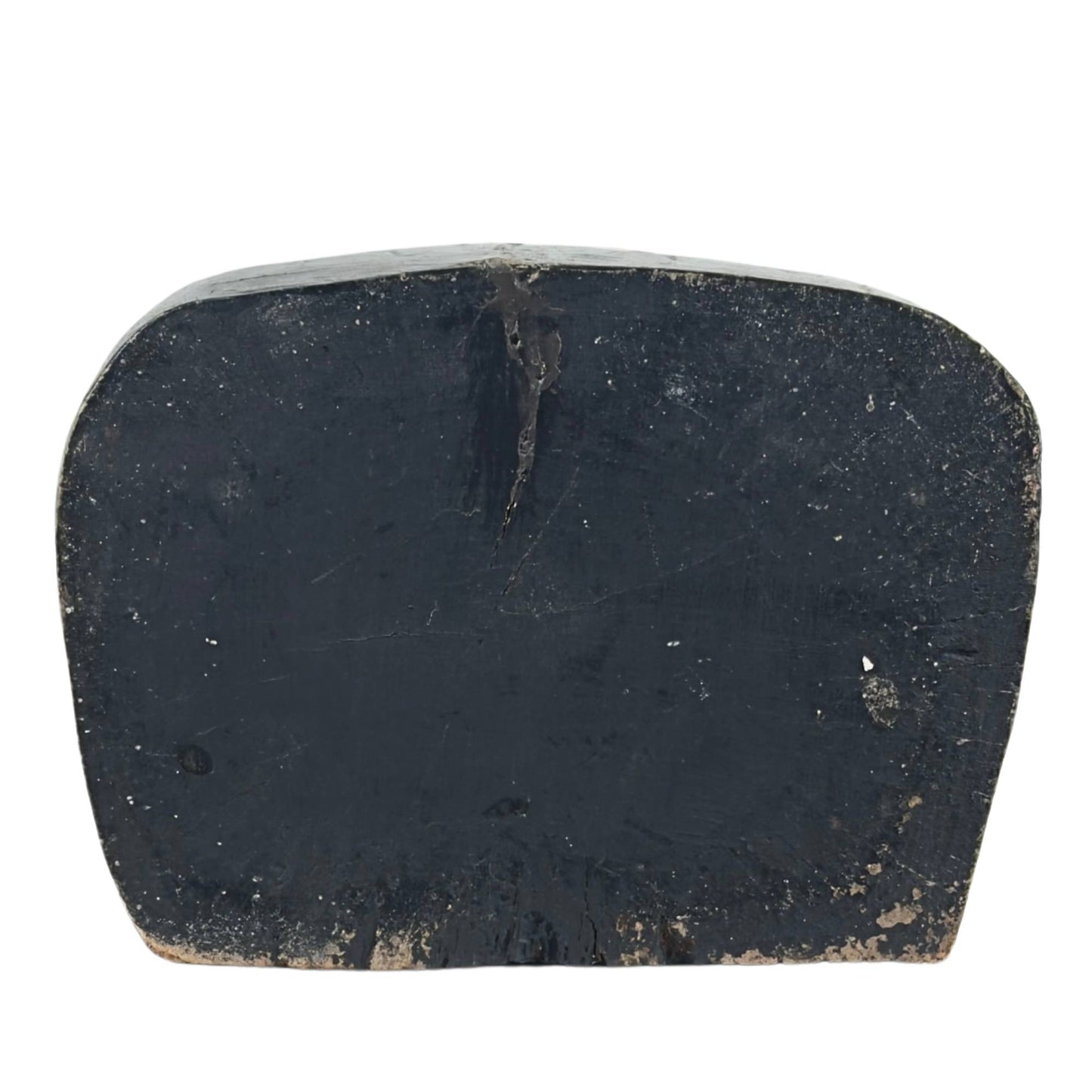
The base provides an unusually useful record of how the sculpture was made and how the wood subsequently aged.
Magnified photographs reveal numerous short, intersecting tool marks across the underside. The base was not machined into a perfectly flat surface; instead, its irregular contours preserve evidence consistent with traditional manual woodworking.
The solid timber has also developed substantial natural shrinkage. A pronounced drying crack extends through part of the lower structure, accompanied by smaller age-related fissures and considerable wear around the edges of the base.
These details are important because they are largely hidden when the sculpture is displayed. They provide additional physical evidence of traditional construction and the long-term movement of the timber.
An Old Sculpture with a History of Restoration
This figure has been repaired and restored during its lifetime.
The major shrinkage crack was stabilised and partially filled during an earlier intervention. Other local areas also show evidence of repair and retouching. We have deliberately documented these features rather than concealing them in the description.
The exact date of these repairs cannot be established visually, and we therefore do not claim that every restoration is contemporary with the original use of the sculpture. What can be observed is that the timber had already undergone significant shrinkage before at least some of these interventions were undertaken.
Dating the Sculpture
We attribute the figure to c. 1890–1930, placing it around the transition from the late 19th to the early 20th century.
This dating is based on the object as a whole rather than any single feature: traditional hand-tool marks, shrinkage of the solid timber, an earlier structural repair, extensive surface wear, multiple decorative layers and surviving areas of gold leaf all contribute to the assessment.
A substantially earlier date cannot be established from visual examination alone, so the sculpture is intentionally offered with the more conservative c. 1890–1930 attribution.
Balinese Craftsmanship on a Large Scale
At 67.8 cm high, this is considerably more imposing than the small decorative Balinese carvings commonly encountered on the market. The tall crown and sharply rising back element create a particularly strong vertical silhouette, while the finely carved jewellery and costume reward examination at close range.
Its appeal lies equally in what has survived and what has disappeared. Areas of gold, red and dark polychromy alternate with exposed preparation and worn wood, creating a surface that records decades of ageing, handling and restoration.
For a collector of Indonesian or Southeast Asian art, these traces of its physical history are an important part of the character of the sculpture rather than imperfections to be disguised.
Object Details
- Object: Antique Balinese carved wood figure
- Subject: Royal, heroic or divine male figure
- Gesture: Sembah, with hands joined before the chest
- Origin: Bali, Indonesia
- Date: c. 1890–1930
- Material: Solid hand-carved wood
- Decoration: Historic polychromy with surviving gold leaf
- Height: 67.8 cm
- Width: 18.5 cm
- Weight: 4 kg
- Condition: Age-related wear, losses to paint and gilding, natural shrinkage cracks and evidence of previous restoration and stabilisation
Price: €2,950