Monumental Antique Green Tara in Fire-Gilded Bronze – Nepal, Probably Late 18th or 19th Century (100 cm)
Couldn't load pickup availability
Monumental Antique Green Tara from Nepal – Fire-Gilded Bronze – Probably Late 18th or 19th Century
PHYSICAL DIMENSIONS
- Height: 100 cm
- Width: 47 cm
- Depth: 7 cm
- Weight: 15.2 kg
- Material: Bronze with remnants of the original fire gilding
- Origin: Kathmandu Valley, Nepal
- Date: Probably late 18th or 19th century
- Technique: Traditional lost-wax casting
A Monumental Example of Traditional Newar Bronze Art
This magnificent sculpture depicts Green Tara (Śyāmatārā), one of the most revered female Bodhisattvas in both Mahayana and Vajrayana Buddhism. Standing an impressive one metre tall, it belongs to a rare group of monumental Nepalese Tara sculptures that seldom become available on today's international art market.
The sculpture was created using the traditional lost-wax casting technique, a process that has been practised by Newar master craftsmen in the Kathmandu Valley for centuries. Every element was first modelled entirely in wax before being cast in bronze, allowing an extraordinary level of detail and artistic refinement impossible to achieve through industrial production methods.
Following extensive examination of the sculpture's construction, surface characteristics, engraved decoration, casting technique, patina, surviving fire gilding and iconography, we consider this to be an authentic antique Nepalese Green Tara.
Its artistic style closely reflects the classical Newar tradition. Several stylistic elements also recall earlier sculptures produced during the late Malla period. As an exact date cannot be confirmed without scientific laboratory analysis, the sculpture has deliberately been valued using a conservative 19th-century attribution, although certain characteristics may indicate an earlier origin.
Artistic Quality
One of the sculpture's most striking features is its elegant Tribhanga posture. The body rests naturally upon the right leg while the hips, torso and head create the graceful triple-curved silhouette that has represented the ideal of feminine beauty within Nepalese and Indian sculpture for centuries.
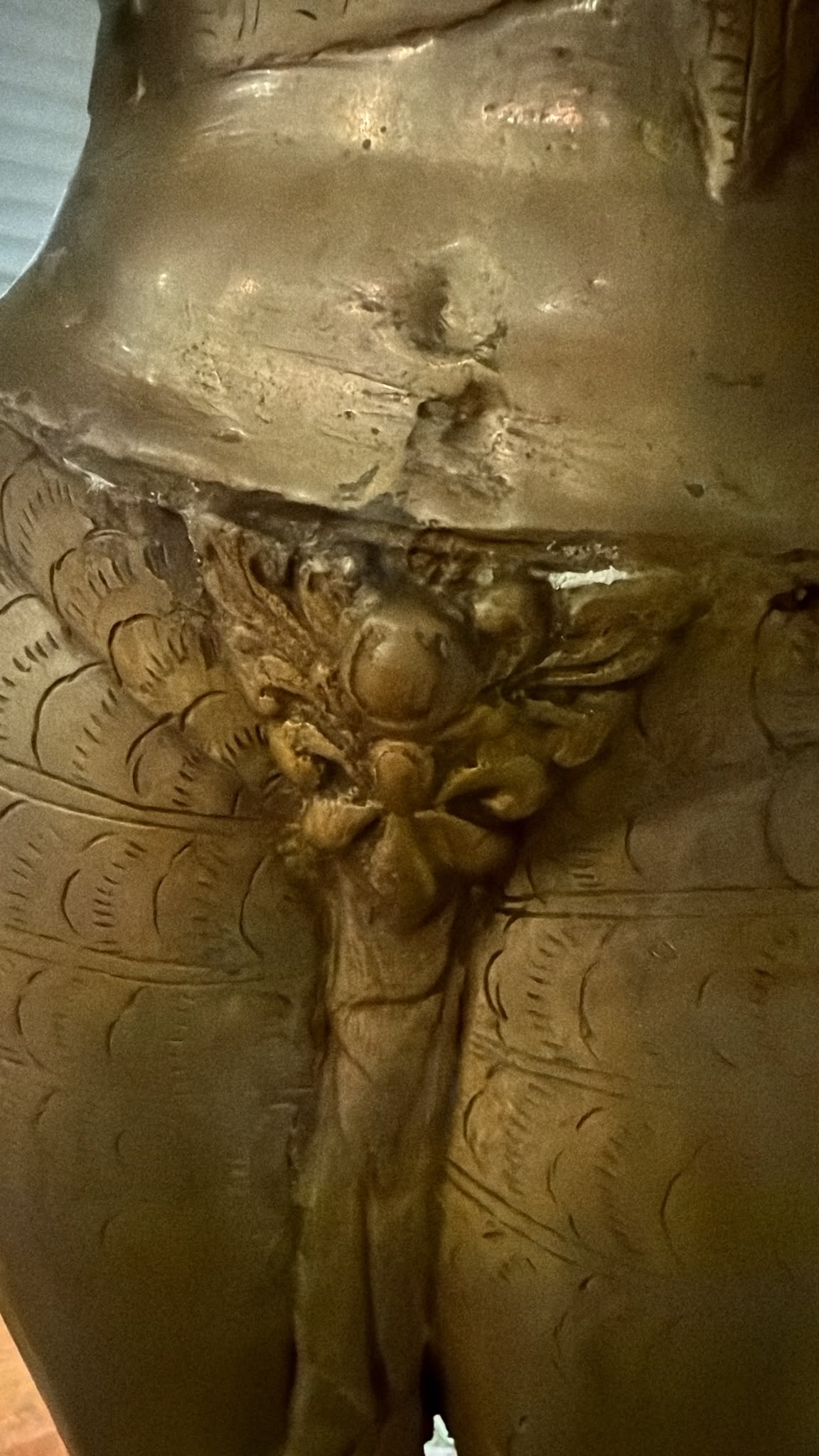
The richly decorated crown, elaborate jewellery, lotus stems and finely engraved garments were individually finished by hand. Under magnification, numerous hand-cut engraving marks and finishing traces remain clearly visible, demonstrating the high level of craftsmanship achieved by the original artist.
Despite its monumental size, the figure possesses remarkable balance and elegance. The refined facial expression, harmonious proportions and beautifully modelled hands reflect the work of an accomplished Newar workshop.
Dating
The sculpture displays numerous stylistic characteristics associated with the classical Newar tradition of the Kathmandu Valley. The posture, iconography, lotus stems, jewellery and ornamental details follow artistic models that remained remarkably consistent throughout Nepalese Buddhist sculpture over many centuries.
Although certain stylistic characteristics could suggest a production date in the late 18th century, the commercial valuation has intentionally been based upon a cautious 19th-century attribution. This conservative approach provides a balanced and well-supported basis for valuation while acknowledging the possibility of an earlier origin.
The combination of its monumental scale, traditional construction techniques and surviving remnants of the original fire gilding makes this an exceptional example of antique Himalayan bronze sculpture.
Research Report & Authenticity Assessment
Every significant object offered by 1stbuddha undergoes an extensive examination before being presented for sale. The purpose of this research is to document traditional manufacturing techniques, age-related characteristics and artistic quality, while comparing the object with published examples from museums, specialist literature and major international auction houses.
For this Green Tara, the construction, casting technique, surface structure, fire gilding, patina, engraved decoration and numerous microscopic details have been carefully examined. Taken together, these observations strongly support the conclusion that this sculpture is an authentic antique bronze created within the Newar tradition of Nepal.
Traditional Lost-Wax Casting
The sculpture was produced using the traditional lost-wax casting process, a technique that has been practiced by Newar bronze casters in the Kathmandu Valley for many centuries. Every section was first modelled entirely in wax before being enclosed in a clay mould. Once heated, the wax melted away and molten bronze was poured into the cavity, producing a unique sculpture that could never be exactly reproduced.
The examination shows that the figure is composed of several individually cast components. The arms, crown, lotus stems and various ornaments were cast separately before being traditionally assembled. This complex method of construction is characteristic of high-quality Nepalese bronze workshops.
Microscopic Examination
The surface was examined using a high-magnification digital microscope. Numerous characteristics consistent with traditionally finished antique bronzes were documented.
- Hand-cut engraved decoration.
- Irregular chisel and finishing marks.
- Natural wear on raised surfaces.
- No evidence of modern machine finishing.
- Minor variations typical of hand craftsmanship.
The engraved decoration on the crown, jewellery and garments reveals individual tool marks under magnification, demonstrating that these details were finished entirely by hand rather than by industrial methods.
Remnants of the Original Fire Gilding
Distinct remnants of the original fire gilding remain visible across several areas of the sculpture. These traces are found not only on exposed surfaces but also within protected recesses and structural joints where later decorative gilding would have served little purpose.
Under magnification, surviving gold can be observed within folds, around old areas of wear and along traditional construction joints. The distribution and gradual transition between the gilding and the underlying bronze are consistent with historical mercury fire gilding that has naturally worn over many decades.
The presence of these surviving gilded areas strongly suggests that the sculpture was originally almost completely fire gilded.
Red Pigment and Lacquer Residues
Small areas of red surface residue are preserved in several locations. Similar traces are regularly encountered on historical Himalayan sculptures and may be associated with ritual pigments, lacquer coatings or centuries of devotional use.
Without laboratory analysis it is not possible to identify the precise composition of these materials. Nevertheless, their appearance and distribution are entirely consistent with the historical character of the sculpture.
Natural Patina
The bronze has developed a rich dark brown to almost black patina with localized reddish-brown and green oxidation. These multiple layers have formed naturally over a long period and correspond closely with the ageing processes expected of an antique copper alloy.
The patina is unevenly distributed, with smooth areas where the sculpture has been touched repeatedly through devotional use, while protected areas retain deeper oxidation and older surface deposits. This pattern of wear appears entirely natural and consistent throughout the sculpture.
Historic Repairs
Several historic repairs were identified during the examination, particularly around traditional construction joints. These repairs display the same ageing characteristics and oxidation as the surrounding bronze, indicating that they are not recent additions.
Such historic repairs are not uncommon on important Nepalese devotional sculptures. Rather than diminishing their significance, they often demonstrate that valuable religious objects were maintained, repaired and preserved over generations instead of being discarded.
Summary of the Technical Examination
The traditional lost-wax construction, hand-cut engraved decoration, naturally developed patina, surviving remnants of the original fire gilding, historic repairs and overall construction together present a highly consistent picture.
In our opinion these characteristics strongly support the attribution of this sculpture as an authentic antique Nepalese Green Tara produced within the Newar tradition. Although scientific laboratory analysis could provide additional information, the sculpture has deliberately been valued on the basis of a conservative 19th-century attribution, despite several stylistic characteristics that may indicate an earlier origin.
Green Tara – The Goddess of Compassion, Protection and Swift Action
Green Tara (Śyāmatārā) is one of the most revered female Bodhisattvas in both Mahayana and Vajrayana Buddhism. For centuries she has been honoured throughout Nepal, Tibet, Bhutan and the Himalayan region as the embodiment of active compassion. While many Buddhist figures symbolize contemplation and inner wisdom, Green Tara represents immediate action. She is believed to respond swiftly to those who seek guidance, protection and spiritual support.
According to Buddhist tradition, Tara was born from a tear shed by Avalokiteshvara, the Bodhisattva of Infinite Compassion. Witnessing the suffering of all living beings, he wept, and from one of his tears Tara appeared. She vowed to remain in female form throughout all future lifetimes, guiding beings toward enlightenment through wisdom, courage and compassion.
The Meaning of the Green Colour
The colour green symbolizes vitality, renewal, wisdom and enlightened activity. Unlike White Tara, who is primarily associated with healing and longevity, Green Tara represents swift assistance and fearless action. She is traditionally invoked to remove obstacles, overcome fear and offer protection during life's most difficult moments.
Within Tibetan Buddhism she is also associated with liberation from the "Eight Great Fears"—both physical dangers and the inner obstacles that prevent spiritual awakening, such as attachment, pride, anger and ignorance.
The Iconography of this Sculpture
This monumental sculpture faithfully follows the traditional Nepalese representation of Green Tara. The graceful Tribhanga posture creates a flowing triple-curved silhouette, giving the figure remarkable elegance despite its monumental size.
Her right hand forms the Varada Mudra, the gesture of generosity, compassion and blessing. It symbolizes Tara's willingness to grant protection, wisdom and spiritual assistance to all beings.
Her left hand displays the Vitarka Mudra, the gesture of teaching and enlightened discussion, while delicately holding the stem of the Utpala lotus. This blue lotus symbolizes purity, spiritual awakening and transcendence, rising immaculate from muddy water just as wisdom emerges from worldly existence.
The Crown and Sacred Ornaments
As is characteristic of the finest Newar sculptures, Tara wears an elaborate crown together with richly decorated necklaces, bracelets, anklets and finely engraved garments. These ornaments should not be understood as expressions of worldly wealth, but rather as symbols of the spiritual perfections attained by an enlightened Bodhisattva.
Under magnification, the engraved decoration reveals numerous individually executed chisel marks, confirming that the details were finished entirely by hand. Such subtle variations are among the hallmarks of traditional craftsmanship and contribute greatly to the sculpture's artistic character.
A Sculpture Created for Devotion
Bronze sculptures of this quality were originally created for temples, monasteries or important private shrines. Over many decades—and often centuries—they served as the focus of daily prayer, meditation, ritual offerings and religious ceremonies. As a result, authentic historical sculptures frequently develop characteristic patterns of wear, natural polishing, ritual residues and complex surface patinas.
This Green Tara displays many of these historic characteristics, including naturally developed patina, remnants of the original fire gilding, historic repairs and traces of red surface residues. Together these features not only support the sculpture's authenticity but also bear witness to its long devotional history.
An Exceptional Collector's Piece
Standing an impressive 100 cm tall, this Green Tara belongs to a relatively rare group of monumental Nepalese bronze sculptures that survive in private hands. Its combination of scale, traditional Newar craftsmanship, artistic quality and extensive research documentation makes it an outstanding acquisition for collectors, galleries and institutions specialising in authentic Himalayan art.
Research Documentation
An extensive research file has been compiled for this sculpture. During the examination, the construction, casting technique, surface characteristics, patina, fire gilding, engraved decoration and numerous microscopic details were carefully documented and compared with published examples of historical Nepalese bronze sculpture.
To maintain a clear and readable product page, not every research image has been included here. However, a selection of the most important documentary photographs accompanies this sculpture and illustrates the principal findings of our examination.
- Microscopic images of the hand-engraved decoration.
- High-magnification photographs showing surviving remnants of the original fire gilding.
- Macro photographs documenting the naturally developed patina and oxidation layers.
- Detailed images of historic repairs and traditional construction methods.
- Close-up photographs of the preserved red pigment and lacquer residues.
- Microscopic documentation of age-related wear and surface characteristics.
- Construction photographs showing individually cast components and traditional assembly techniques.
- Ultraviolet (UV) examination images used during the technical assessment.
Together, these photographs provide valuable insight into the sculpture's manufacture, construction, condition and long history of devotional use. Additional high-resolution research photographs can be provided to serious collectors upon request prior to purchase.
Conclusion
This monumental Green Tara represents an outstanding example of traditional Newar bronze sculpture. Its elegant composition, traditional lost-wax construction, finely executed hand engraving, naturally developed patina, historic repairs and surviving remnants of the original fire gilding combine to create a sculpture of exceptional artistic and historical significance.
Based upon our examination of the construction, surface characteristics, iconography and manufacturing techniques, a date in the late 18th or 19th century appears entirely plausible. For valuation purposes, however, the sculpture has deliberately been assessed using a conservative 19th-century attribution, providing a careful and balanced commercial valuation while acknowledging the possibility of an earlier origin.
Standing one metre high, this Green Tara belongs to a relatively rare category of monumental Nepalese devotional sculpture. Works of this scale and quality seldom become available on the international art market, making this an exceptional opportunity for collectors of authentic Himalayan art.
Authenticity
Every important object offered by 1stbuddha Research undergoes a detailed examination before being presented for sale. Construction, casting technique, iconography, surface characteristics, patina, engraved decoration and age-related wear are carefully documented and compared with published examples from museums, academic literature and international auction catalogues.
The attribution and dating presented for this sculpture are based upon art historical comparison, technical examination and many years of experience in the field of antique Asian sculpture. As is standard practice within the international art market, such attributions represent informed professional opinions rather than absolute scientific certainty.
Specifications
- Subject: Green Tara (Śyāmatārā)
- Origin: Kathmandu Valley, Nepal
- Date: Probably late 18th or 19th century
- Material: Bronze with remnants of the original fire gilding
- Technique: Traditional lost-wax casting
- Height: 100 cm
- Width: 47 cm
- Depth: 7 cm
- Weight: 15.2 kg
- Condition: Well-preserved antique condition with age-related wear, naturally developed patina, historic repairs and surviving remnants of the original fire gilding.
Shipping
Due to its size and weight, this sculpture will be professionally packed and shipped with full insurance. Personal collection by appointment is also welcome. Worldwide shipping is available, with transport arranged according to the destination and the specific requirements of the object.
Should you require further information regarding the sculpture's research, condition or provenance, or if you would like to receive additional high-resolution photographs or technical documentation, we will be pleased to assist you.