Important Tibetan Sakya Lineage Thangka of Hevajra – Early Ngor Tradition, Second Half of the 15th Century
Couldn't load pickup availability
Important Tibetan Sakya Lineage Thangka of Hevajra – Early Ngor Tradition, Second Half of the 15th Century
Dimensions
- Height: 89.5 cm
- Width: 65 cm
- Original silk brocade mounting: No longer present
This exceptional Tibetan lineage thangka ranks among the most important religious paintings we have examined in recent years. Over a period of several months, the work underwent extensive art historical research that included iconographic analysis, translation of historical Tibetan inscriptions, complete translation of the rear colophon, identification of the depicted lineage masters, examination of ritual Rañjanā inscriptions and comparison with documented examples from the Sakya and Ngor traditions.
Rather than relying on a single stylistic observation, every aspect of the painting was investigated independently before the results were compared. Remarkably, each line of research pointed toward the same conclusion: a high-quality Sakya lineage thangka associated with the early Ngor tradition and most likely produced during the second half of the fifteenth century.
An Exceptional Religious Painting
At the centre of the composition appears Hevajra, the principal meditational deity of the Lamdré transmission preserved within the Sakya School of Tibetan Buddhism. Surrounding the central deity is an elaborate arrangement of lineage masters, protector deities, ḍākinīs and wealth deities, carefully organised to represent the uninterrupted transmission of one of Tibetan Buddhism's most important esoteric teachings.
Unlike many later devotional paintings that focus primarily on decorative richness, this composition reveals a carefully structured spiritual programme. Every figure occupies a deliberate position, guiding the viewer through the visual history of the lineage itself.
Beneath many of the principal figures are finely executed gold inscriptions. High-resolution photography and subsequent translation enabled the identification of several historically important Sakya masters, including:
- Chögyal Phagpa Lodrö Gyeltsen
- Zhangtön Könchok Pel
- Nyenchen Sönam Tenpa
- Ngorchen Kunga Zangpo
In addition, numerous important deities were identified, including Amitāyus, Hevajra, Brahmarūpa Mahākāla, Siṃhamukhā, Jetsün Dagmema, Vaiśravaṇa and Jambhala. Together they form a religious programme that corresponds closely with the Lamdré transmission of the Sakya tradition.
A Reconstructed Historical Lineage
One of the most remarkable discoveries made during the research concerned the sequence of the lineage masters themselves. Initially these figures appeared to represent a selection of important Sakya teachers. However, once their inscriptions had been translated, it became evident that they formed a carefully organised historical transmission extending across several centuries.
The identified lineage begins with Chögyal Phagpa Lodrö Gyeltsen (1235–1280), one of the greatest Sakya masters in Tibetan history and spiritual advisor to Kublai Khan. It continues through Zhangtön Könchok Pel and Nyenchen Sönam Tenpa before reaching Ngorchen Kunga Zangpo (1382–1456), founder of Ngor Monastery and one of the central figures in the development of the Ngor branch of the Sakya tradition.
This reconstruction dramatically changed the interpretation of the painting. Rather than depicting unrelated historical personalities, the thangka preserves a carefully documented spiritual transmission whose internal chronology corresponds closely with the historical development of the Lamdré tradition.
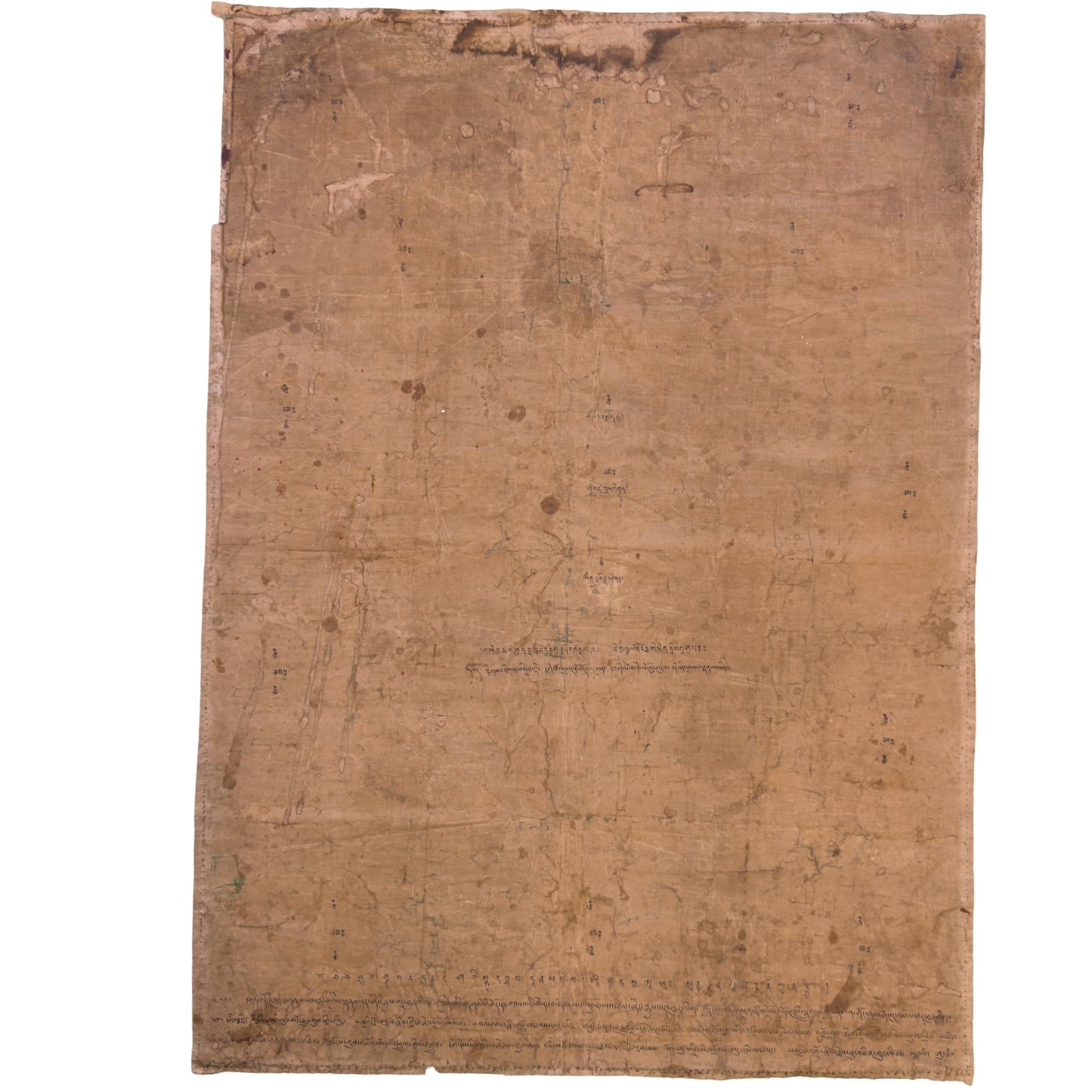
The significance of this reconstruction increased even further after the extensive Tibetan colophon on the reverse side of the painting was translated. There, the historical name of Dzözin Gyeltsen Rinchen appears as commissioner of the work, creating a direct historical connection between the painted lineage and the documentary evidence preserved on the reverse.
Historical Colophon
The reverse of the thangka proved to be just as remarkable as the painted composition itself. Rather than containing a few ownership marks or short devotional inscriptions, the entire reverse is covered with an extensive Tibetan colophon. Such texts are traditionally used to record religious intentions, prayers, lineage affiliations and, in exceptional cases, historical information relating to the creation of the work.
The translation of this colophon became one of the most important stages of the research. The text opens with classical Buddhist verses, including the well-known teaching:
"Avoid all evil; cultivate virtue; thoroughly tame your own mind. This is the teaching of the Buddha."
Further sections contain prayers for the flourishing of the Dharma, the prosperity of the patron, the growth of the Saṅgha and the liberation of all sentient beings. More importantly, the colophon explicitly refers to the Lamdré tradition and records the name of Dzözin Gyeltsen Rinchen as commissioner of the painting.
This discovery established a direct historical link between the documented lineage represented on the front of the thangka and the written historical record preserved on the reverse. Rather than functioning solely as a devotional object, the painting also preserves valuable documentary evidence concerning its religious context and intended purpose.
Rañjanā Consecration Inscriptions
Surrounding the colophon are numerous ritual inscriptions executed not in standard Tibetan script but in the classical Rañjanā (also known as Lantsa) script. This highly decorative Sanskrit script was traditionally reserved for sacred mantras, seed syllables and consecration formulas throughout the Himalayan Buddhist world.
One of the most remarkable observations made during the research was the precise placement of these inscriptions. They are positioned directly behind the principal figures painted on the front of the thangka, corresponding with the traditional locations associated with the body, speech and mind of the enlightened beings represented.
The reverse therefore functions not merely as documentary evidence but as part of the original consecration ritual. Painting and inscription were conceived as a single religious whole, transforming the thangka into a fully empowered ritual object rather than a simple devotional image.
Although portions of these Sanskrit inscriptions remain difficult to translate because of their highly stylised Rañjanā script, their presence provides important evidence for the ritual sophistication of the painting and reflects practices deeply rooted within the Vajrayāna tradition.
Art Historical Research
The conclusions presented in this study are based upon multiple independent lines of investigation rather than a single stylistic observation. Throughout the research every significant feature of the painting was examined separately before being evaluated as part of the complete historical picture.
- Complete iconographic analysis.
- Identification of the historical lineage masters.
- Translation of the Tibetan colophon.
- Translation of the gold inscriptions beneath the principal figures.
- Analysis of the Rañjanā consecration inscriptions.
- Study of composition, painting technique and stylistic characteristics.
- Examination of the exceptionally fine woven support.
- Comparison with documented Sakya and Ngor lineage paintings.
Rather than producing conflicting interpretations, each independent line of research reinforced the others. The iconography supports the lineage, the lineage corresponds with the historical colophon, and both are further strengthened by the ritual inscriptions preserved on the reverse.
Religious Significance
This thangka was never intended as decorative artwork. It was created as an advanced ritual image serving the transmission of the Lamdré teachings within the Sakya tradition of Tibetan Buddhism.
Every deity, lineage master and protector occupies a carefully defined position within the composition. Together they present a visual representation of spiritual transmission extending across generations of teachers who preserved one of Tibetan Buddhism's most profound esoteric traditions.
The central presence of Hevajra confirms the painting's close relationship with the Lamdré cycle, while the surrounding lineage masters emphasise that this work functioned as both a devotional image and a visual record of authentic spiritual transmission.
Artistic Quality
Independent of its historical importance, the artistic execution of this thangka is exceptional. Even after centuries of use and natural ageing, the painting preserves an extraordinary level of precision. Individual facial expressions remain remarkably refined, the robes are decorated with intricate gold patterns, and the entire composition demonstrates a level of technical control associated with highly accomplished workshop production.
The figures are carefully balanced within the composition, creating a harmonious visual rhythm despite the large number of deities and lineage masters represented. Nothing appears overcrowded or accidental. Every element contributes to the spiritual hierarchy of the painting, reflecting the intellectual and artistic discipline of its creator.
The Textile Support
One of the first observations made during the examination concerned the remarkably fine textile support. At first glance the material appeared almost paper-like because of its thinness, yet closer inspection revealed an exceptionally fine woven fabric prepared specifically for high-quality religious painting.
The painting layer has become fully integrated with the textile over centuries of natural ageing. The craquelure, pigment layer and woven fibres all exhibit consistent wear, indicating that the painting and support have aged together as a single object.
The quality of the textile allowed the artist to execute an extraordinary amount of detail, particularly within the gold decoration and the delicate facial modelling that characterises the finest Tibetan paintings.
Mineral Pigments and Gold
The colour palette is dominated by deep blues, rich reds, vibrant greens and extensive gold detailing. These pigments display the depth and complexity commonly associated with traditional mineral-based painting techniques used throughout the Himalayan region.
Particularly impressive is the extensive use of gold. Rather than serving merely as decoration, the gold is employed to define garments, jewellery, halos, floral motifs and countless microscopic ornamental details. Under magnification these decorations reveal thousands of individual brushstrokes executed entirely by hand.
The technical quality of this gilded decoration demonstrates remarkable artistic discipline and reflects a workshop capable of producing paintings of exceptional refinement.
Condition
The thangka survives in an honest and authentic state consistent with centuries of devotional use. The original silk brocade mounting is no longer present, allowing the painted textile itself to be examined in detail.
Expected age-related characteristics such as craquelure, minor pigment losses, folds and areas of wear are visible throughout the painting. These features should not be regarded as defects but rather as evidence of the object's long religious history. Importantly, the principal composition, historical inscriptions and iconographic programme remain remarkably well preserved.
Rarity
Lineage thangkas of this calibre are exceptionally scarce. Even rarer are examples that preserve such a substantial amount of historical information. This painting combines identifiable lineage masters, a translated Tibetan colophon, ritual Rañjanā consecration inscriptions and a coherent historical transmission within a single object.
Very few surviving Tibetan paintings allow such a comprehensive reconstruction of their religious context. As a result, this thangka should be regarded not only as an important devotional work but also as a valuable historical document preserving aspects of the Sakya and Ngor traditions that extend far beyond its artistic qualities alone.
A Museum-Level Research Object
This thangka represents far more than an outstanding example of Tibetan religious painting. It brings together history, ritual practice, lineage transmission and exceptional artistic craftsmanship within a single surviving object.
The extensive research undertaken has transformed what initially appeared to be an anonymous religious painting into one of the most thoroughly documented objects within our collection. Every stage of the investigation—from iconographic analysis and historical reconstruction to the translation of inscriptions—has contributed to a deeper understanding of the work and its place within Tibetan Buddhist history.
For collectors, institutions and museums, this represents a rare opportunity to acquire an important Tibetan lineage thangka supported by extensive art historical documentation and ongoing academic research.
Specifications
- Object: Tibetan Lineage Thangka
- Tradition: Sakya – Ngor
- Religious Cycle: Lamdré
- Central Deity: Hevajra
- Date: Probably second half of the 15th century (c. 1450–1490)
- Origin: Tibet
- Material: Fine handwoven textile, mineral pigments and gold
- Condition: Authentic age-related wear consistent with centuries of devotional use
Research Dossier
An extensive research dossier accompanies this thangka. It includes the complete translation of the Tibetan colophon, identification of the historical lineage masters, reconstruction of the Lamdré transmission, analysis of the Rañjanā inscriptions and a comprehensive art historical evaluation.
The complete research is available through 1stbuddha.com and will continue to expand as new historical sources, comparative material and scholarly insights become available.