A 19th-Century Tibetan Buddha with a Remarkably Preserved Surface History
Couldn't load pickup availability
Regular price
$1,987.00 USD
Regular price
Sale price
$1,987.00 USD
| Dimensions: | H 20 × W 15 cm |
| Weight: | 1.2 kg |
| Material: | Bronze with traces of historic gilding |
| Origin: | Tibet / Himalayan region |
| Period: | 19th century |
| Subject: | Seated Buddha in Bhumisparsha Mudra |
A Buddha That Defies First Impressions
This Tibetan bronze serves as a compelling reminder that antique sculptures should not be judged solely by their initial aesthetic impact. Placed on a table, one might easily mistake the figure for a much more contemporary piece; parts of the surface exhibit an unusual smoothness and luster often associated with mid-20th-century production.
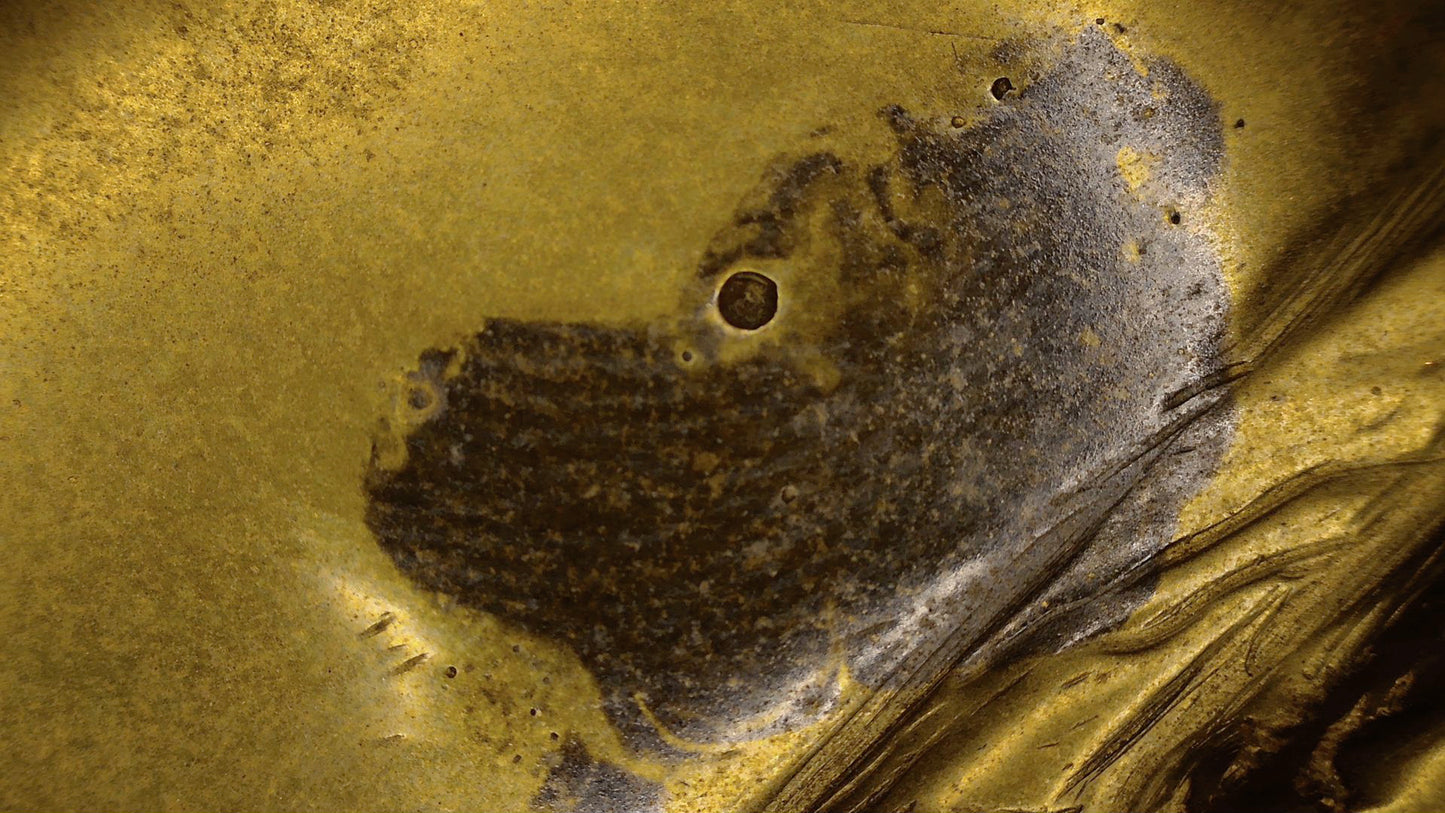
Yet, it is precisely this ambiguity that makes the sculpture so intriguing. Under microscopic examination, the narrative shifts entirely. What appears to the naked eye as a simplified, polished surface reveals itself to be a complex composition of distinct historical zones, featuring dark patination, oxidation, historic abrasions, and vestigial traces of an original gilded finish.
Surviving Beneath the Polish
It is evident that at some point in its history, the bronze underwent a rigorous cleaning or polishing process. This intervention resulted in the loss of a significant portion of the original surface on the exposed, accessible areas.
Fortunately, such cleaning rarely reaches every crevice. Traces of older surface layers remain preserved along the nape of the neck, between the curls of the hair, within small recesses, and around the lotus throne. These areas display a considerably more nuanced and varied patina than the highly polished sections.
Surface Composition: Patina and Gilding
Under high magnification, the surface reveals a layered history: dark brown deposits, charcoal-toned patches, warm copper-hued areas, and zones of exposed grey metal sit in close proximity. These are punctuated by fine, antique scratches—some of which disappear beneath later-developed surface changes, while others cut through established patination—creating a surface history of multiple distinct developmental phases rather than a uniform, artificial "antique" look.
Traces of Historic Gilding
Of particular interest are the small gold-toned areas visible under the microscope. These remnants do not lie uniformly across the figure; instead, they are primarily preserved in locations sheltered from abrasion. In several instances, one can observe the gradual transition where the gold layer fades into a dark patina and ultimately into exposed metal.
Why These Details Matter
The preserved gilding follows the irregularities of the metal surface with remarkable precision, extending even into deep recesses and hand-tooled marks. This wear pattern is consistent with historic metallic gilding and the characteristics of traditional fire-gilding techniques. Beyond the physical chemistry, the critical insight is that these residues are intrinsically linked to the older patination zones, confirming they are original to the piece rather than a modern decorative addition.
Internal Construction and Casting
Rotating the sculpture reveals a stark contrast to the smooth exterior. The bronze is traditionally hollow-cast; the interior exhibits an irregular casting surface with pits, rough patches, and historic sediment—areas deliberately left unfinished as they were not intended to be visible.
This discrepancy between the meticulously smoothed, hand-finished exterior and the coarse, industrial internal structure is entirely consistent with the traditional lost-wax casting methods used for hollow-cast Buddhist bronzes.
Iconography: The Earth-Touching Buddha
The figure is seated serenely on a double lotus throne. The left hand rests in the lap, while the right hand reaches over the knee to touch the earth. This gesture is known as the Bhumisparsha Mudra, evoking the pivotal moment just before Siddhartha’s enlightenment, when he summoned the earth to witness his spiritual perfection. It remains one of the most classic and revered representations of the historical Buddha Shakyamuni.
Attribution and Condition
We attribute this Buddha to the 19th century. This assessment is not based on a single diagnostic feature, such as a dark patina, but rather on a holistic evaluation of the traditional hollow-casting technique, the manual finishing, the complex surface stratification, the remnants of historical gilding, and the stylistic placement within the Tibetan-Himalayan bronze tradition.
We deliberately maintain a conservative dating. While specific features are compelling, we lack sufficient independent evidence to justify an earlier attribution. The sculpture bears clear marks of its age, including old scratches, local oxidation, and areas of wear. These differences have been documented but intentionally left untouched; a renewed intensive cleaning would risk removing the very traces that document the object's creation and subsequent history.
A Piece for the Second Glance
Standing 20 cm tall, this is not a monumental temple bronze; rather, its allure lies in its subtlety. It elegantly demonstrates how little the modern surface of an antique bronze can reveal about its true age. At a glance, one sees a classic seated Tibetan Buddha. Under closer inspection, it reveals a far richer history of patina, craftsmanship, and metalwork—a 19th-century bronze that preserves its most fascinating stories in the smallest of details.