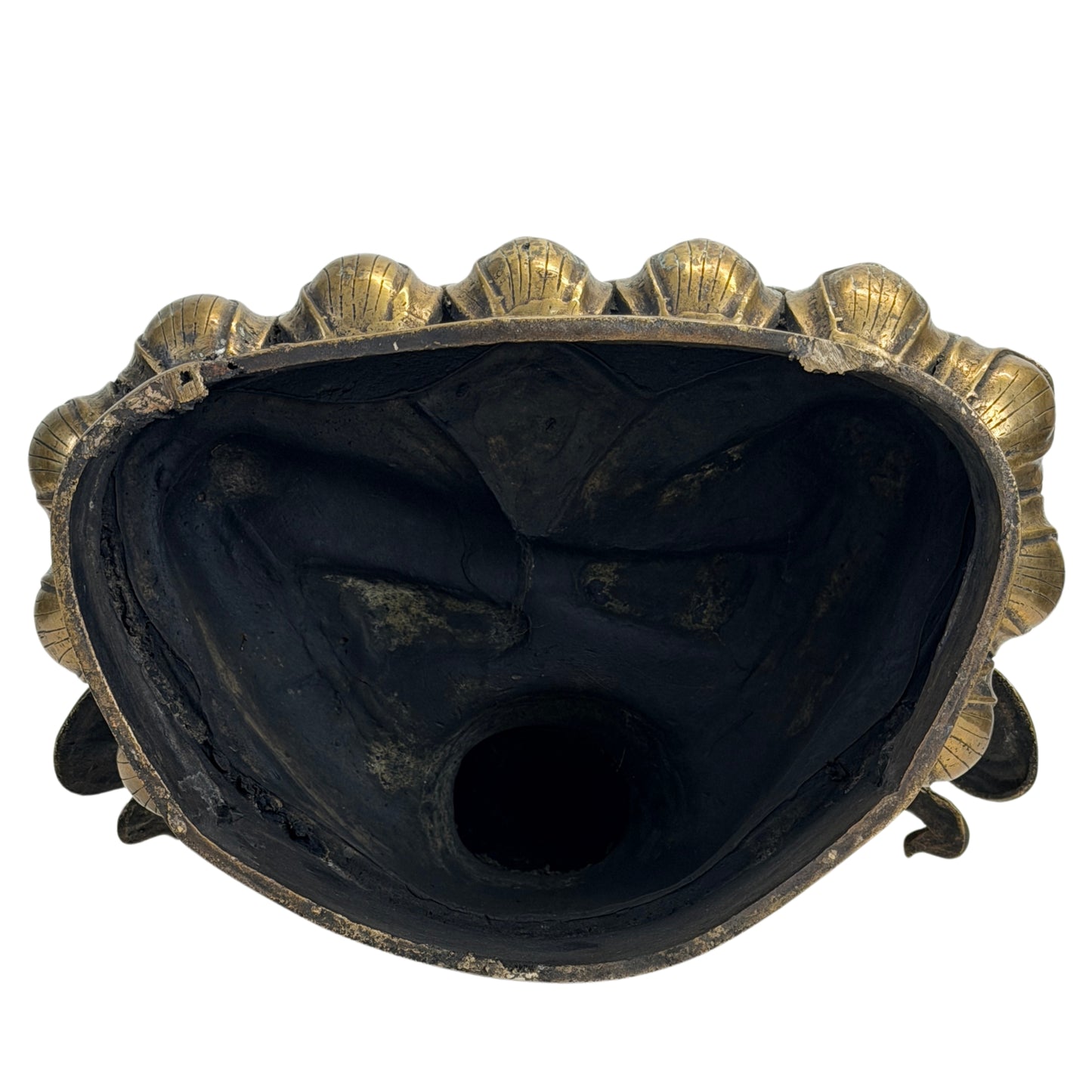
Monumental Tibetan Vajrasattva Bronze Sculpture – 19th Century – 40.5 cm
Couldn't load pickup availability
Regular price
$18,325.00 USD
Regular price
Sale price
$18,325.00 USD
Dimensions: H 40.5 × W 27.5 cm
Weight: 5.4 kg
Material: Copper-rich bronze with historic fire gilding
Origin: Tibet / Himalayan region
Period: 19th century
Subject: Vajrasattva (Dorje Sempa)
Provenance feature: Historic Nepalese inspection/export seal, provisionally dated to the mid-20th century
A Fine and Monumental Gilt-Bronze Figure of Vajrasattva
This substantial gilt-bronze figure depicts Vajrasattva (Dorje Sempa), one of the principal deities associated with purification within Tibetan Vajrayana Buddhism. At 40.5 cm in height and weighing 5.4 kg, the sculpture possesses the scale, weight and visual authority of an important devotional image.
Seated in dhyanasana upon a broad double-lotus throne, Vajrasattva holds the vajra in his raised right hand and the ghanta, or ritual bell, in his left. Together these attributes represent the union of method and wisdom, a fundamental principle of tantric Buddhist practice.
Artistic Character
Tibetan Form with Newar Influence
The sculpture belongs to the sophisticated Tibetan-Himalayan bronze tradition while displaying a pronounced debt to the metalworking traditions of the Newar craftsmen of the Kathmandu Valley.
This influence is particularly apparent in the elaborate crown, large circular ear ornaments, layered jewellery and finely worked textile decoration. The garments are enriched with extensive hand-engraved floral ornament, lending the surface a remarkable degree of refinement when viewed at close range.
Individual decorative elements also reveal the wider artistic exchange between Tibet, Nepal and China. Rather than suggesting a single isolated workshop tradition, these features place the sculpture within the interconnected artistic world in which prestigious Himalayan Buddhist bronzes were produced.
Historic Fire Gilding
Extensive areas of the original gold surface remain preserved. The gilding survives most strongly within protected recesses, engraved lines, ornamental borders and areas less exposed to repeated handling.
Natural Wear of the Gilded Surface
Microscopic examination reveals a gradual transition from intensely gilded areas to more subdued gold-brown and exposed copper-rich surfaces. Projecting elements display greater wear, while immediately adjacent recesses retain considerably stronger traces of gold.
The surviving metallic layer closely follows the underlying texture of the bronze, without prominent foil-like edges or large areas of lifting associated with an applied leaf surface. The observed morphology is consistent with historic mercury-amalgam fire gilding, a technique widely associated with high-quality Himalayan copper-alloy sculpture.
The uneven preservation of the gilding is an important part of the object's historic surface. Gold, darker deposits, local oxidation and exposed bronze coexist naturally across areas subjected to different degrees of handling and protection.
Hand-Finished Decoration
The sculpture was extensively refined after casting. Flowing floral designs, ornamental borders and smaller geometric elements were engraved by hand across the garments.
Under magnification, subtle variations in the depth, width and direction of individual engraved lines remain visible. Dark deposits have accumulated within some of the deeper cuts, creating a natural contrast with the smoother surrounding surfaces.
The combination of substantial casting and delicate post-casting work demonstrates the considerable attention devoted to both the sculptural form and its final decorative finish.
Historic Nepalese Inspection and Export Seal
An especially noteworthy feature is the survival of a small Nepalese inspection/export seal, still attached to the sculpture by its old cord.
The reddish sealing material displays pronounced shrinkage, cracking, brittle edges and minor losses consistent with considerable age. Based on current research, the seal is provisionally associated with Nepalese inspection and export practices of the mid-20th century, probably circa 1950–1960.
A Provenance Marker Rather Than a Place of Manufacture
The seal should be understood as evidence for a later episode in the sculpture's history rather than as an indication that the bronze itself was manufactured in Nepal.
Tibetan religious objects circulated extensively through the Himalayan region, and Nepal became an important point of passage for Buddhist works entering international collections during the 20th century.
The seal therefore provides a valuable fixed point within the object's later provenance: the sculpture was already present in Nepal by the time of the associated inspection or export procedure.
Dating and Attribution
The sculpture is conservatively attributed to Tibet / the Himalayan region, 19th century.
This assessment is based upon the casting, substantial construction, hand-finished ornament, surviving historic gilding, surface development and the relationship between Tibetan iconography and Newar-derived decorative conventions.
Certain stylistic and technical characteristics invite comparison with earlier, late-18th-century Himalayan bronzes. In the absence of stronger independently datable evidence, however, the broader 19th-century attribution is retained.
Condition and Technical Examination
The bronze retains a complex historic surface with extensive gilding, natural wear, local oxidation, minor scratches and accumulated deposits. These characteristics have not been artificially unified through aggressive modern refinishing.
Selected areas were examined using macro photography and microscopy, with particular attention paid to the gilding, engraved decoration, protected recesses and transitions between exposed and less accessible surfaces.
The historic Nepalese seal and its attachment have likewise been preserved as part of the object's provenance.
Collector's Note
Combining monumental scale, substantial 5.4 kg casting, historic fire gilding, finely engraved decoration, strong Newar influence and an unusually preserved Nepalese provenance seal, this Vajrasattva represents a particularly compelling example of 19th-century Tibetan-Himalayan Buddhist metalwork.
Its importance lies not only in its visual presence, but also in the survival of multiple layers of its history: the original sculptural and decorative craftsmanship, the naturally aged gilded surface and a tangible record of its later passage through Nepal.