-
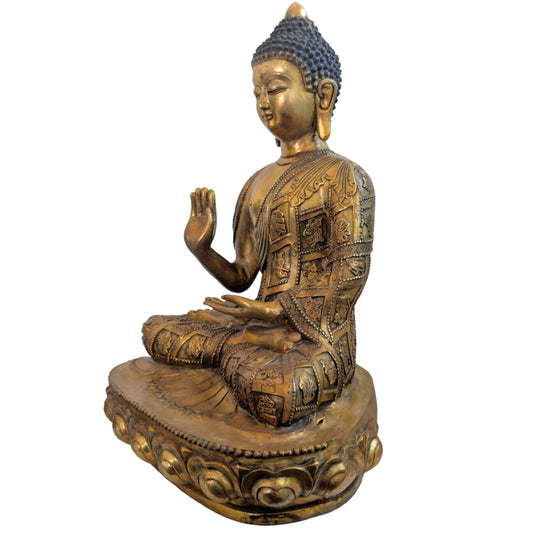
Monumental Fire-Gilded Buddha – Tibetan Rattanakosin Style – 44 cm / 6.4 kg
Regular price $2,494.00 USDRegular price -
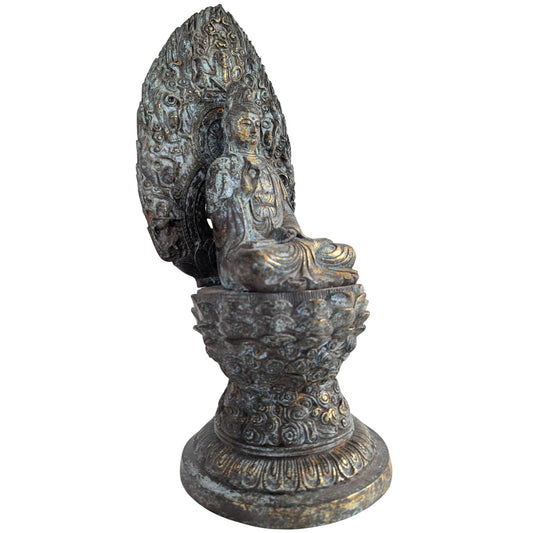
The Patroness of Compassion – Monumental Chinese Guanyin on Lotus Base – 36.5 cm – 3.5 kg
Regular price $690.00 USDRegular price


The Monday Buddha – known in Thailand as Pang Ham Yati – is one of the most iconic representations in Thai Buddhist art. In this posture, the Buddha stands upright with his right hand raised, palm facing forward. This gesture is known as the Abhaya mudra, the sign of protection, reassurance, and the removal of fear.
This posture refers to an important moment in the Buddha's life. He returned to his native region and found a conflict between two groups fighting over water rights. Instead of intervening with power or authority, he raised his hand. This simple gesture brought calm, tranquility, and ultimately peace.
The power of this image lies in its simplicity. No movement, no action – only presence. It is precisely this silent power that makes the Monday Buddha so special.
Within Thai tradition, this posture is directly linked to Monday. People born on this day are seen as intelligent, thoughtful, and often strong in communication. They have a natural tendency to avoid conflict, yet simultaneously possess the ability to stabilize situations when necessary. An authentic Monday Buddha is recognizable by:
* the standing posture
* the raised right hand (sometimes both hands)
* the open palm facing forward
* a calm, neutral facial expression
In older Thai styles, such as Sukhothai and Ayutthaya, you often see a strong emphasis on elegance and flowing lines. The posture is slightly bent forward, which conveys a sense of movement and liveliness, despite the stillness of the gesture.
What makes this Buddha unique within an interior or collection is the immediate aura of peace and protection. The image “works” visually: it stops the space, as it were. It brings balance and prevents visual clutter.
For collectors, the focus lies on details such as hand position, proportions, and finish. The fingers and the position of the hand are particularly crucial. In authentic pieces, these are subtly shaped and never stiff or unnatural.
Within the broader context of Thai Buddha postures, the Monday Buddha is one of the most accessible and at the same time most powerful images. It is a posture that is immediately understood, even without knowledge of its background. At 1stbuddha, we select only Monday Buddhas that meet the correct iconography and style. No decorative interpretations, but images that are accurate in content and preserve the original meaning.
This posture refers to an important moment in the Buddha's life. He returned to his native region and found a conflict between two groups fighting over water rights. Instead of intervening with power or authority, he raised his hand. This simple gesture brought calm, tranquility, and ultimately peace.
The power of this image lies in its simplicity. No movement, no action – only presence. It is precisely this silent power that makes the Monday Buddha so special.
Within Thai tradition, this posture is directly linked to Monday. People born on this day are seen as intelligent, thoughtful, and often strong in communication. They have a natural tendency to avoid conflict, yet simultaneously possess the ability to stabilize situations when necessary. An authentic Monday Buddha is recognizable by:
* the standing posture
* the raised right hand (sometimes both hands)
* the open palm facing forward
* a calm, neutral facial expression
In older Thai styles, such as Sukhothai and Ayutthaya, you often see a strong emphasis on elegance and flowing lines. The posture is slightly bent forward, which conveys a sense of movement and liveliness, despite the stillness of the gesture.
What makes this Buddha unique within an interior or collection is the immediate aura of peace and protection. The image “works” visually: it stops the space, as it were. It brings balance and prevents visual clutter.
For collectors, the focus lies on details such as hand position, proportions, and finish. The fingers and the position of the hand are particularly crucial. In authentic pieces, these are subtly shaped and never stiff or unnatural.
Within the broader context of Thai Buddha postures, the Monday Buddha is one of the most accessible and at the same time most powerful images. It is a posture that is immediately understood, even without knowledge of its background. At 1stbuddha, we select only Monday Buddhas that meet the correct iconography and style. No decorative interpretations, but images that are accurate in content and preserve the original meaning.