-
Monumental Chinese reclining Tongzi - a decorative 1920s piece
Regular price $2,297.00 USDRegular price -
Antique reclining bronze Buddha from Thailand with remnants of gilding Parinirvana statue 77 cm
Regular price $4,610.00 USDRegular price -
Antique Reclining Bronze Buddha – 55cm
Regular price $806.00 USDRegular price -
Hand-carved Reclining Buddha — Mid-20th Century XXL
Regular price $1,711.00 USDRegular price

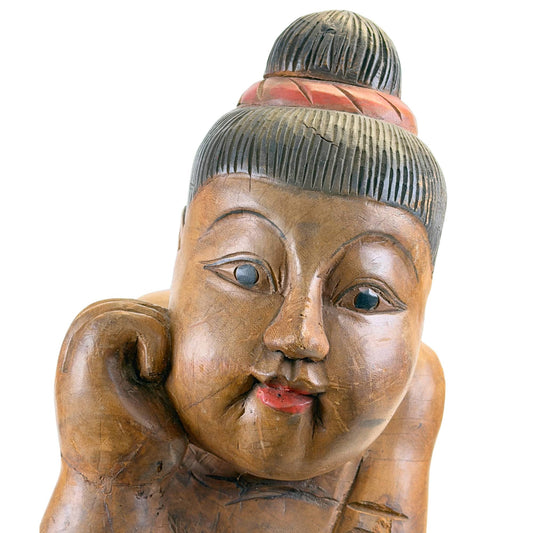

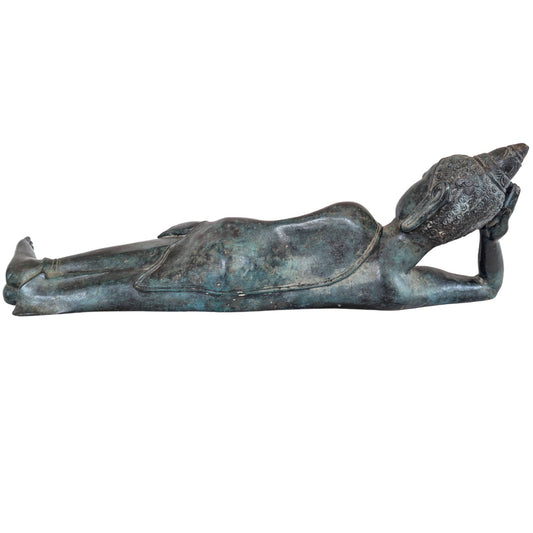

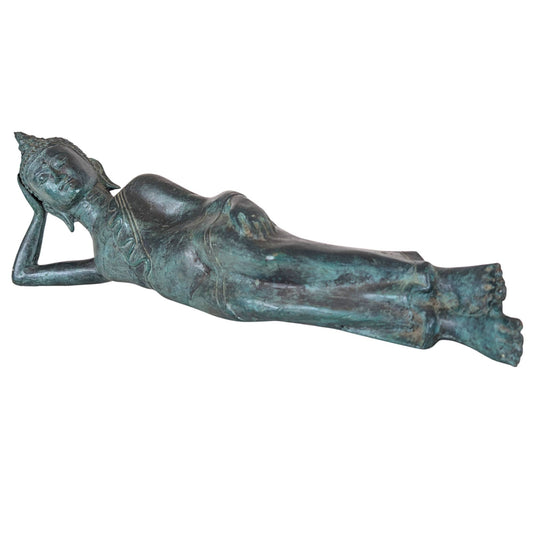

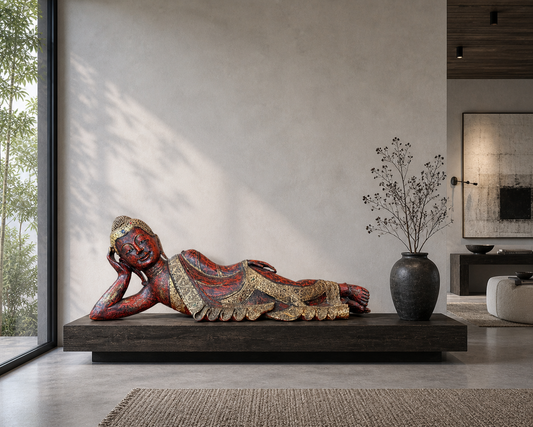
The reclining Buddha – internationally known as the Reclining Buddha or Parinirvana Buddha – is one of the most meaningful postures within Buddhism. In this depiction, the Buddha lies on his right side, with his head resting on his hand, completely relaxed yet simultaneously consciously present.
This posture refers to the moment of his final transition: entering Parinirvana. This is not death in the ordinary sense, but the definitive letting go of all earthly ties and the attainment of complete enlightenment.
What makes this depiction so special is the combination of tranquility and depth. While many Buddha statues show strength or meditation, the reclining Buddha shows something else: acceptance. No struggle, no resistance, but complete surrender.
Within the Thai tradition, there is also a specific interpretation in which this posture is linked to the story of the encounter with the giant Asura Rahu. In this context, the Buddha demonstrates his inner strength by adjusting his form and thereby breaking through pride and arrogance – without violence. An authentic reclining Buddha is recognizable by:
* lying on the right side
* the head supported by the right hand
* a relaxed, gentle facial expression
* flowing lines in the body and robe
In larger temple statues, you often see additional symbolism, such as inlaid feet with patterns representing the cosmos. In smaller sculptures, the focus is more on posture, proportion, and finish.
The reclining Buddha is often chosen by people seeking peace in their surroundings. The statue radiates calmness and brings visual stillness to a space. At the same time, it carries a deeper layer: the realization that letting go is not a loss, but a form of freedom.
For collectors, the execution plays a major role. Old examples show subtle wear, natural patina, and a softness of form that is often lacking in modern reproductions. The transition between head, hand, and body, in particular, requires craftsmanship and is an important indicator of quality.
Within the birth day tradition, this posture is associated with Tuesday. People born on this day are seen as energetic, direct, and courageous. The reclining Buddha brings balance to that – stillness versus action.
At 1stbuddha, we select reclining Buddha statues that are not only visually right but also accurate in content. No mass production, but pieces that combine the right posture, proportion, and presence.
This posture refers to the moment of his final transition: entering Parinirvana. This is not death in the ordinary sense, but the definitive letting go of all earthly ties and the attainment of complete enlightenment.
What makes this depiction so special is the combination of tranquility and depth. While many Buddha statues show strength or meditation, the reclining Buddha shows something else: acceptance. No struggle, no resistance, but complete surrender.
Within the Thai tradition, there is also a specific interpretation in which this posture is linked to the story of the encounter with the giant Asura Rahu. In this context, the Buddha demonstrates his inner strength by adjusting his form and thereby breaking through pride and arrogance – without violence. An authentic reclining Buddha is recognizable by:
* lying on the right side
* the head supported by the right hand
* a relaxed, gentle facial expression
* flowing lines in the body and robe
In larger temple statues, you often see additional symbolism, such as inlaid feet with patterns representing the cosmos. In smaller sculptures, the focus is more on posture, proportion, and finish.
The reclining Buddha is often chosen by people seeking peace in their surroundings. The statue radiates calmness and brings visual stillness to a space. At the same time, it carries a deeper layer: the realization that letting go is not a loss, but a form of freedom.
For collectors, the execution plays a major role. Old examples show subtle wear, natural patina, and a softness of form that is often lacking in modern reproductions. The transition between head, hand, and body, in particular, requires craftsmanship and is an important indicator of quality.
Within the birth day tradition, this posture is associated with Tuesday. People born on this day are seen as energetic, direct, and courageous. The reclining Buddha brings balance to that – stillness versus action.
At 1stbuddha, we select reclining Buddha statues that are not only visually right but also accurate in content. No mass production, but pieces that combine the right posture, proportion, and presence.