An 18th-Century Indian Bronze Huqqa Vessel with Engraved Decoration
Couldn't load pickup availability
Regular price
$532.00 USD
Regular price
Sale price
$532.00 USD
Dimensions: H 20.5 × W 8 cm
Weight: 600 g
Material: Cast bronze / copper alloy
Origin: Northern India
Period: 18th century
Culture: Indo-Persian / Mughal tradition
A small object from India's smoking culture
There is something immediately intriguing about the shape of this vessel. It is only 20.5 cm high, yet its elongated body, projecting side element and sharply tapering lower section give it an unusually architectural silhouette.
The form belongs to the material culture surrounding the Indian huqqa. During the Mughal and post-Mughal periods, smoking developed into an important social ritual throughout northern India, resulting in an extraordinary variety of vessels made in metal, glass, ceramic and other materials.
This compact example was cast in a substantial copper-rich alloy and weighs approximately 600 grams.
Made to be handled
Unlike highly ceremonial court pieces covered in elaborate precious-metal decoration, this vessel has the character of an object that was meant to be used.
The surface is marked by scratches, small dents, softened edges and considerable variation in colour. Areas that were exposed to repeated handling have developed differently from protected recesses, where considerably darker material remains.
Decoration cut directly into the metal
Fine engraved lines can be seen across the body. Their depth and spacing are not perfectly uniform, and under magnification the individual movements of the engraving tool remain visible.
The ornament is deliberately restrained. Rather than overwhelming the form, the engraved decoration follows and emphasizes the contours of the vessel.
The bronze tells more than the silhouette
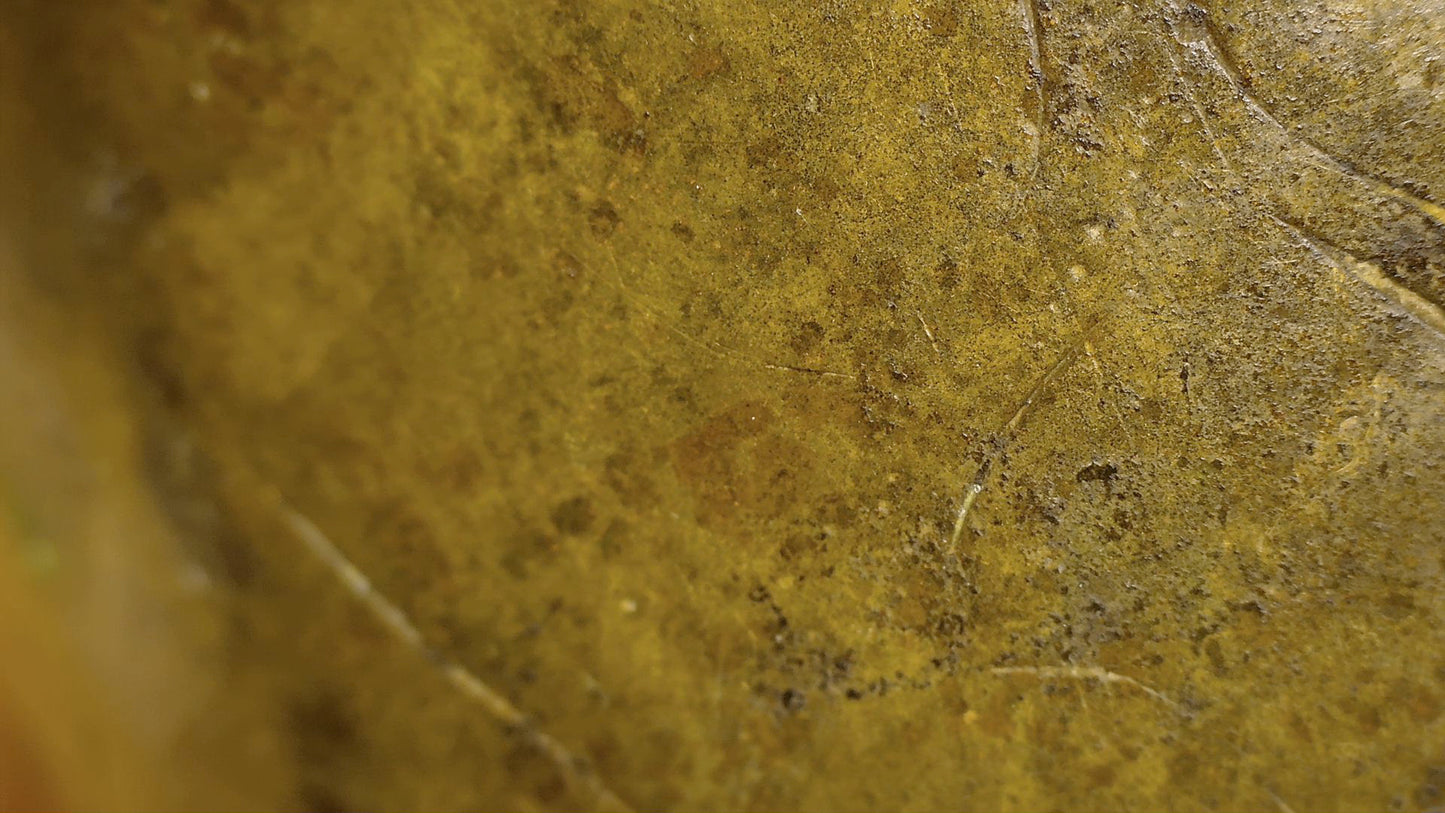
Viewed normally, much of the vessel appears almost black. Under magnification, however, this apparently simple surface separates into numerous distinct areas.
Deep brown patination lies beside warmer copper-toned metal. Small pockets contain green copper corrosion, while other areas reveal striking yellow-gold surfaces. Old scratches pass through some of these layers and have themselves subsequently developed further oxidation.
This creates a surface that records several stages of handling, wear and chemical change rather than a single uniform finish.
Possible remains of an earlier gilded surface
Several microscopic areas display particularly bright gold-coloured material surviving amongst the darker patina.
These may represent remnants of historic gilding. We deliberately leave this attribution open: without elemental analysis it is not possible to distinguish with certainty between surviving gold and exposed yellow-toned areas of the underlying historic copper alloy.
Whatever their precise composition, these protected areas are an important part of the vessel's complex historic surface and have therefore been left untouched.
An object shaped by the Indo-Persian world
The culture of northern India during the 18th century cannot be separated neatly into purely Indian or Persian artistic traditions. Centuries of exchange had created a visual language in which Persian forms, Mughal court culture and regional Indian craftsmanship continually influenced one another.
This vessel belongs within that broader Indo-Persian metalworking tradition.
Its restrained engraved decoration and compact cast construction differ considerably from later tourist objects made merely to imitate Mughal forms.
Why we retain an 18th-century attribution
The dating is based on the object as a whole rather than on patina alone. The casting, form, hand engraving, accumulated wear and complex surface history are consistent with an 18th-century attribution.
We currently place the vessel in Northern India during the 18th century. Without an inscription, maker's mark or documented early provenance, a more specific workshop attribution would go beyond the available evidence.
Condition
The vessel remains in historic condition with extensive signs of age and use. These include scratches, small impacts, surface irregularities, dark patination and localized green copper corrosion.
The surface has not been polished back to bright metal. This is particularly important here, as much of the character and information preserved on the vessel exists within precisely these old surface layers.
A survivor rather than a showpiece
At only 20.5 cm, this is a relatively small object, but it rewards close examination. What initially appears to be a simple dark bronze reveals engraved workmanship, extensive handling and a remarkably varied metal surface.
It is precisely this combination that gives the vessel its appeal: not perfection, but the physical evidence of an object that has survived from the material culture of 18th-century northern India.
An unusual piece of Indo-Persian metalwork with a particularly expressive historic surface.