Antique Chinese Kwan Yin with Shancai & Longnü – Late Qing Dynasty – 60 cm
Couldn't load pickup availability
Dimensions: H 60 cm
Weight: approx. 9 kg
Material: Hand-carved and assembled bone
Origin: China
Period: Late Qing Dynasty, 19th century
Depiction: Guanyin (Kwan Yin) with Shancai and Longnü
Technique: Multi-piece construction, hand carving, engraving and pigmented details
Guanyin Surrounded by Her Traditional Attendants
At the heart of this remarkable Chinese sculpture sits Guanyin, the Bodhisattva of Compassion. She is accompanied by Shancai and Longnü, creating one of the most recognizable devotional groupings within Chinese Mahayana Buddhism.
The sculpture immediately impresses through its scale. Standing 60 cm high and weighing approximately 9 kg, it is a substantial work composed of numerous individually carved elements rather than a single piece of material.
A Richly Layered Buddhist Composition
Guanyin occupies the calm centre of an extraordinarily elaborate scene. Around her, smaller figures, lotus forms, rocky structures and ornamental elements create a composition intended to be explored gradually rather than understood from a single viewpoint.
Shancai represents the young pilgrim in search of wisdom, while Longnü, the Dragon Girl, is closely associated with enlightenment within Chinese Buddhist tradition. Their presence alongside Guanyin gives the sculpture a distinctly Chinese religious identity.
Built Piece by Piece
The construction is one of the most fascinating aspects of the sculpture. Its considerable size was achieved through the careful assembly of many separately carved pieces of bone.
Faces, hands, robes, architectural details, lotus petals and decorative elements were individually shaped before becoming part of the complete group. Close inspection reveals numerous joins that demonstrate just how technically demanding such a large composition was to produce.
The pale surface is enriched with extremely fine engraving. Dark pigment remains within many of these incised lines, defining textile patterns, facial details and ornamental borders with remarkable precision.
Craftsmanship Revealed Under Magnification
Microscopic examination provides an entirely different view of the sculpture. Areas of wear and exposed material reveal the natural internal structure of the bone, while carved surfaces preserve minute traces left by cutting, scraping and engraving tools.
The magnified surfaces also show variations that cannot be appreciated with the naked eye: tiny channels within the material, irregular hand-cut grooves, accumulated material within recessed decoration and subtle differences between polished and less accessible areas.
These observations help document both the material and the extensive manual workmanship involved in creating the sculpture.
Chinese Carving from the Late Qing Period
The combination of elaborate Buddhist iconography, segmented construction and dense decorative carving places the sculpture within the tradition of Chinese craftsmanship associated with the late Qing Dynasty in the 19th century.
What makes the work particularly successful is the contrast between complexity and serenity. Almost every surrounding surface contains ornament, movement or narrative detail, yet Guanyin herself remains composed and meditative at the centre.
Carved Mark Beneath the Sculpture
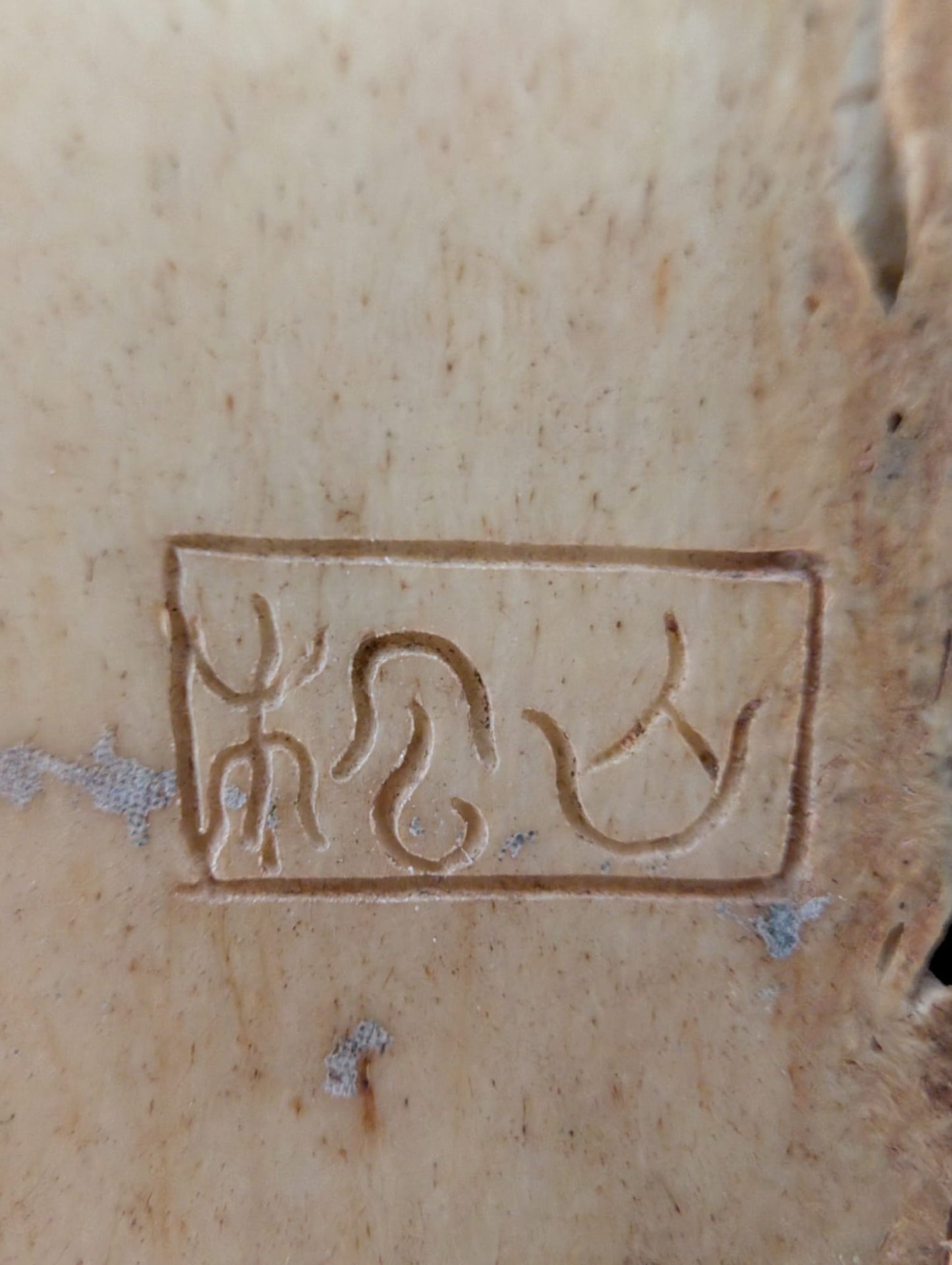
A hand-cut mark enclosed within a rectangular cartouche appears on the underside. It forms part of the original construction and may relate to the maker or workshop responsible for the piece.
The mark has not been assigned to a named carver, as its precise reading and attribution cannot presently be established with sufficient certainty. It is therefore retained as an important feature of the sculpture without making an unsupported attribution.
A Major Decorative and Collecting Piece
At 60 cm high and approximately 9 kg, this is far removed from the small-scale bone carvings more commonly encountered on the market. Its size allows the craftsmanship to operate on several levels: from the overall silhouette of Guanyin to minute details that become visible only at close range.
Displayed in an Asian art collection, a refined interior or a dedicated contemplative space, the sculpture has enough scale and visual complexity to stand independently as a focal point.
An impressive example of late Qing Chinese Buddhist carving, combining the traditional imagery of Guanyin, Shancai and Longnü with ambitious scale, intricate handwork and an unusually complex multi-piece construction.