Antique Red Tara Thangka – 19th Century Newar Buddhist Painting from Nepal
Couldn't load pickup availability
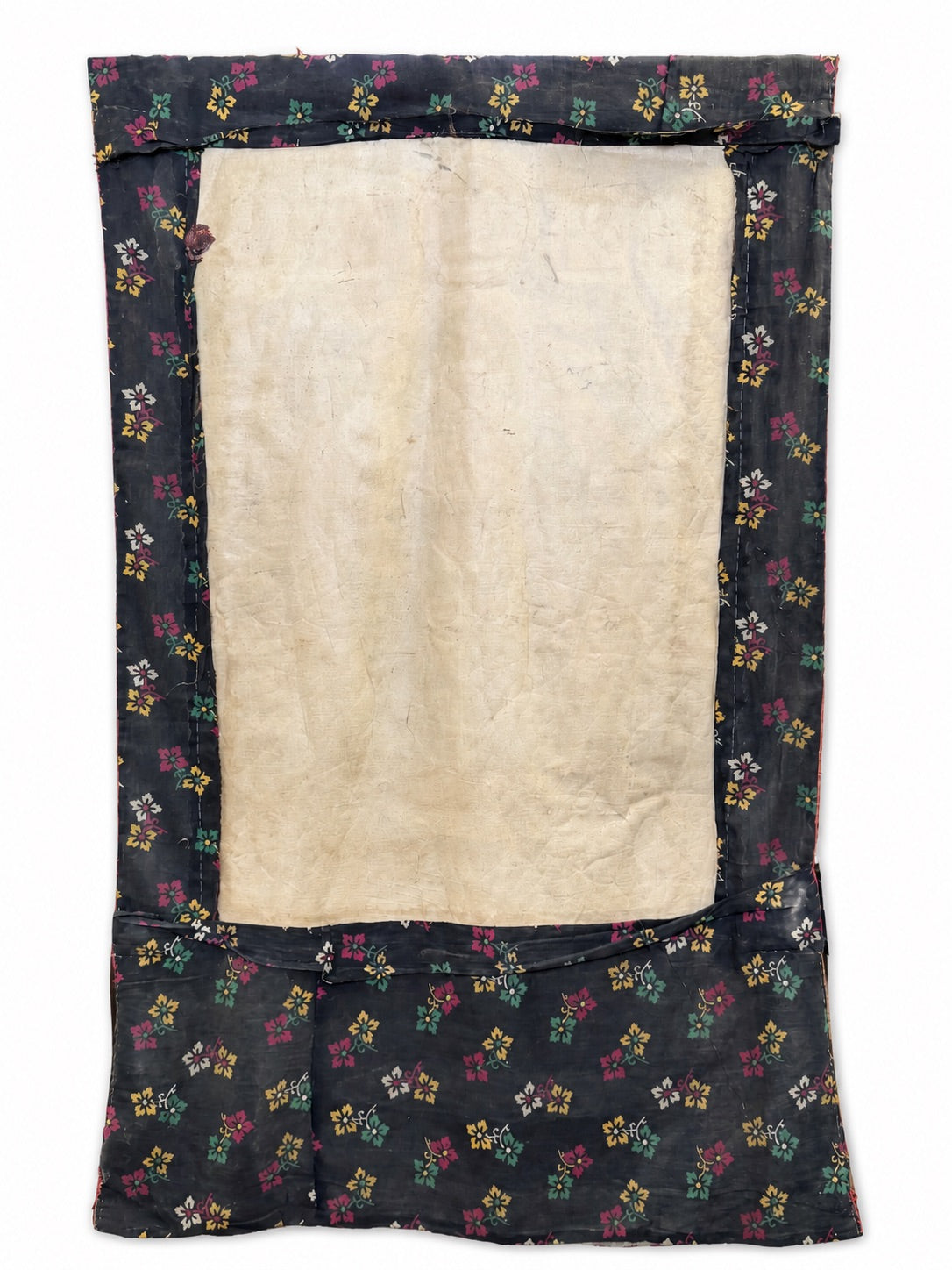
Dimensions: H 120 × W 73 cm, including the textile mounting
At first sight, it is the colour that commands attention. A brilliant red female deity rises against a deep blue field, surrounded by a carefully ordered celestial assembly. Only on closer inspection does the extraordinary amount of detail become apparent: tiny divine figures, elaborate jewellery, flowering lotuses, patterned garments and layers of hand-painted ornament that transform this large religious painting into an intricate visual world.
This is an antique 19th-century Buddhist painting from Nepal, traditionally known in the Newar artistic tradition as a paubha and internationally more commonly recognised under the broader term thangka. Measuring an impressive 120 cm in height, the painting centres upon Rakta Tara, the Red Tara.
Red Tara – a powerful female presence
Tara is one of the most important female figures in Himalayan Buddhism. In this unusual red manifestation she appears standing rather than seated, her body gently curved in an elegant tribhanga posture.
The artist has deliberately emphasised her feminine form. Her red body is adorned with necklaces, bracelets, anklets and an elaborate crown, while a long flowering lotus rises beside her shoulder.
Her lowered right hand is opened in Varada Mudra, the gesture associated with generosity, giving, blessings and the fulfilment of wishes. Her other hand delicately holds the stem of the large lotus.
An especially intriguing feature is the spotted animal skin draped across her left shoulder. Combined with the lotus, jewellery and elaborate costume, it gives this particular representation an unusually rich iconographic character.
Why is Tara red?
Colour is never incidental in Himalayan Buddhist art. Red is traditionally associated with magnetising activity: the ability to draw favourable circumstances, beneficial relationships, opportunities and necessary resources towards the practitioner.
For this reason, Red Tara is associated with themes of prosperity, abundance, attraction and wish fulfilment. These ideas are reinforced here by the open Varada Mudra of her right hand.
The symbolism is broader than material wealth alone. Buddhist abundance also concerns having the conditions required for spiritual development: protection, knowledge, supportive relationships, opportunity and freedom from obstacles.
A universe painted around Tara
The central figure is only the beginning of the painting. Around Tara is an extensive assembly of smaller deities, each occupying its own circular halo or cloud-filled space.
They differ in colour, posture, number of arms and attributes. Some are peaceful, others more forceful. Together they turn the composition into a complete religious image rather than a simple devotional portrait.
The arrangement is remarkably disciplined. The smaller figures create a rhythmic framework around the towering red deity, while the dark blue ground makes the reds, greens, yellows and whites appear exceptionally intense.
This combination of precise organisation and saturated colour is one of the characteristics that gives historic Newar painting its unmistakable visual power.
Paubha or thangka?
The distinction is worth making.
In Nepal, particularly among the Newar communities of the Kathmandu Valley, traditional religious scroll paintings are known as paubha. The closely related Tibetan tradition uses the term thangka.
For centuries Nepal and Tibet were connected by pilgrimage, religion, artistic commissions and trade. Newar painters were highly respected throughout the Himalayan world, and their influence can be recognised far beyond the Kathmandu Valley.
Today, “antique thangka” is the term most international collectors immediately recognise, but for a Nepalese Newar work such as this, paubha is the more specific traditional name.
A painting that still carries its history
This work has not been stripped of the evidence of its age. Numerous old fold lines cross the painted surface. There are areas of craquelure, pigment loss, abrasion and discolouration, while the surrounding textile shows extensive wear of its own.
These imperfections are part of the character of the object. Under magnification the painting reveals hand-drawn outlines, variations within the pigment layers and extensive natural ageing across the painted surface.
Rather than presenting the appearance of a recently produced decorative thangka, the work retains the unmistakable visual presence of an object that has survived generations of handling and use.
A dated Nepalese export mark: 1976
One detail makes its later history particularly fascinating.
The painting bears an old Nepalese seal associated with its export history. The seal carries the date 2033 Bikram Sambat, corresponding to 1976 AD.
It provides a fixed historical point in the object's biography: this already historic religious painting was present in Nepal by 1976 and subsequently left the country.
Such a dated physical mark is particularly desirable on an antique Himalayan artwork because its history is not dependent solely upon a modern label or an undocumented story. Part of that history remains physically attached to the object itself.
19th-century comparisons in major collections
The wider artistic tradition can be studied through important works preserved and published by international institutions.
Himalayan Art Resources documents a large 19th-century Himalayan painting centred on a red deity and extensive surrounding pantheon, catalogued as item 65564 and associated with the Rubin Museum of Art. The work is dated 1800–1899 and provides valuable comparative material for the broader tradition in which monumental red deities were represented within elaborate divine assemblies.
A further important comparison appeared at Christie's in the John C. and Susan L. Huntington Collection. Christie's catalogued the painting as Nepalese and probably 19th century. Its intense palette, red central deity and arrangement of subsidiary figures demonstrate the sophisticated visual language found in historic Nepalese religious painting.
These works are cited as art-historical comparisons only; they are not presented as provenance for the present painting.
Made to dominate a sacred space
At 120 × 73 cm, this is not a small cabinet painting. Its vertical proportions allow the central Red Tara to dominate the composition while the surrounding deities become progressively more detailed as the viewer approaches.
That change in viewing experience is part of the strength of the work. From across a room it reads as a powerful red divine presence against blue. At close range it becomes an intricate hand-painted world of faces, halos, flowers, jewellery and ritual symbolism.
Key details
- Subject: Rakta Tara / Red Tara
- Object: antique Buddhist thangka / Newar paubha
- Origin: Nepal, Kathmandu Valley tradition
- Date: 19th century
- Dimensions: H 120 × W 73 cm including textile mounting
- Technique: traditional hand-painted pigments on prepared textile
- Iconography: standing Red Tara with lotus, Varada Mudra and surrounding pantheon
- Historical mark: Nepalese export-related seal dated 2033 B.S. / 1976 AD
- Condition: extensive authentic age and use-related wear, including old folds, craquelure, abrasion, discolouration and areas of pigment loss
A large 19th-century Nepalese Red Tara painting with the scale, complexity and untouched historic character that make early Himalayan religious paintings so compelling — further distinguished by a dated Nepalese export mark from 1976.