-
Kneeling bronze Buddha in Anjali mudra – Burma, 18th–19th century
Regular price $377.00 USDRegular price

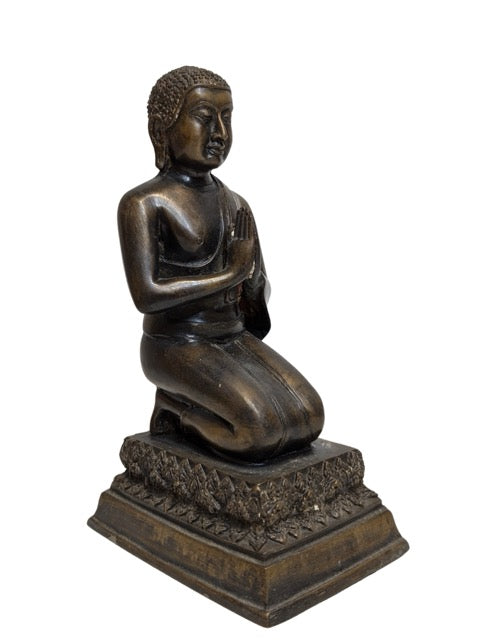
The Anjali Mudra – also known as the gesture of greeting or reverence – is one of the most fundamental hand gestures within Buddhism and other Asian traditions. In this posture, both palms are placed against each other, usually at chest level.
Unlike many other mudras, which represent specific events in the Buddha's life, the Anjali Mudra revolves around a universal principle: respect and balance.
The gesture is used in greetings, rituals, and moments of gratitude. In Thailand and other parts of Asia, this is visible daily in the form of the traditional “wai” – a greeting in which the hands are brought together in the same way.
Within Buddha statues, the Anjali Mudra symbolizes:
* respect and humility
* inner and outer balance
* connection between man and the spiritual world
* recognition without ego
What makes this posture special is its symmetry. Both hands are equal; both sides of the body work together. This makes it a powerful visual symbol of harmony. A Buddha in Anjali Mudra is less focused on meditation or protection, and more on interaction. It is an outward-directed gesture, without aggression or dominance. It invites tranquility, but also connection.
Authentic statues with this mudra are recognizable by:
* both hands placed together
* position at chest or face level
* symmetrical and natural finger position
* relaxed yet conscious body posture
For collectors, the execution of the hands is particularly important. The fingers must fit together smoothly and should not appear stiff or mechanical. This is often a clear distinction between handmade work and mass production.
Within an interior, the Anjali Mudra Buddha works differently than other poses. While meditation statues bring tranquility and protective poses radiate strength, this pose creates a sense of welcome and openness.
It is therefore an ideal choice for:
* entrances
* reception areas
* places where connection is central
At 1stbuddha, we select Buddha statues with Anjali Mudra based on correct execution and balance. No exaggerated interpretations, but images that respect the simplicity and power of this gesture.
For those seeking a Buddha that not only brings peace but also radiates connection, the Anjali Mudra is one of the purest choices.
Unlike many other mudras, which represent specific events in the Buddha's life, the Anjali Mudra revolves around a universal principle: respect and balance.
The gesture is used in greetings, rituals, and moments of gratitude. In Thailand and other parts of Asia, this is visible daily in the form of the traditional “wai” – a greeting in which the hands are brought together in the same way.
Within Buddha statues, the Anjali Mudra symbolizes:
* respect and humility
* inner and outer balance
* connection between man and the spiritual world
* recognition without ego
What makes this posture special is its symmetry. Both hands are equal; both sides of the body work together. This makes it a powerful visual symbol of harmony. A Buddha in Anjali Mudra is less focused on meditation or protection, and more on interaction. It is an outward-directed gesture, without aggression or dominance. It invites tranquility, but also connection.
Authentic statues with this mudra are recognizable by:
* both hands placed together
* position at chest or face level
* symmetrical and natural finger position
* relaxed yet conscious body posture
For collectors, the execution of the hands is particularly important. The fingers must fit together smoothly and should not appear stiff or mechanical. This is often a clear distinction between handmade work and mass production.
Within an interior, the Anjali Mudra Buddha works differently than other poses. While meditation statues bring tranquility and protective poses radiate strength, this pose creates a sense of welcome and openness.
It is therefore an ideal choice for:
* entrances
* reception areas
* places where connection is central
At 1stbuddha, we select Buddha statues with Anjali Mudra based on correct execution and balance. No exaggerated interpretations, but images that respect the simplicity and power of this gesture.
For those seeking a Buddha that not only brings peace but also radiates connection, the Anjali Mudra is one of the purest choices.